侪
Character Story & Explanation
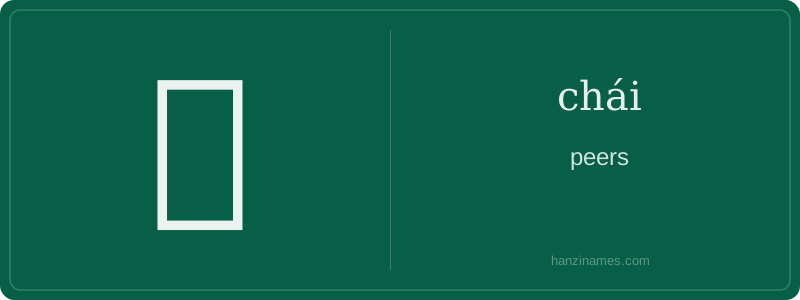
侪 is predominantly used in classical and modern formal writing — especially in idioms like 吾侪 (wú chái, 'we, our group') and 尔侪 (ěr chái, 'you all, your group'), both appearing in historical texts and modern editorials to evoke collective identity with gravitas. It's common in political speeches, literary essays, and newspaper headlines to refer to 'our generation' or 'our peers' with rhetorical unity. The phrase 吾侪虽微 (wú chái suī wēi, 'Though we are humble') appears in contemporary commentary on civic responsibility.
The character is not pictographic; it evolved from seal script where the 亻 (person) radical combined with 齐 (qí, 'even, aligned') — originally meaning 'to equalize'. This reflects its semantic core: people brought into alignment or parity. No oracle-bone form exists; its earliest attestation is in Warring States bamboo slips, confirming its use for denoting peer groups in bureaucratic and philosophical contexts.
The character 侪 (chái) is a classical and literary term meaning 'a class' or 'peers' — specifically, people of the same rank, status, or social group. Unlike common modern words like 同学 (tóngxué, 'classmate') or 同事 (tóngshì, 'colleague'), 侪 carries formal, often poetic or historical weight. It appears mostly in written Chinese, idioms, and scholarly discourse, rarely in casual speech. Its tone is neutral to respectful, evoking solidarity or shared identity among equals.
In Western cultural equivalents, 侪 aligns closely with Latin-derived terms like 'peer group' or 'cohort', especially in academic or military contexts (e.g., 'the officer corps', 'our generation'). It’s not equivalent to 'class' in socioeconomic terms (like Marx’s 'bourgeoisie') nor to 'grade level' (like 'senior class'). Instead, it emphasizes relational parity — similar to how 'fellow' functions in 'fellow scholars' or 'fellow citizens', retaining dignity and collective agency.
This character reflects Confucian-influenced social thinking: identity is rooted in relational roles rather than individual traits. While English uses adjectives ('peer', 'fellow') or nouns ('cohort', 'set'), 侪 functions exclusively as a noun denoting an inclusive, bounded human group bound by shared station — not blood, geography, or profession alone, but recognized equivalence. Its rarity in daily speech underscores its function as a marker of refined, intentional community — a linguistic artifact of literati culture still valued in formal writing and rhetoric today.
Example Sentences
Common Compounds
Similar Characters — Don't Mix These Up
Your First Step into Chinese Culture: Get a Chinese Name
Every journey into Chinese begins with a name. Use our free Chinese name generator to create a meaningful, personalized Chinese name that fits you perfectly.
Get My Chinese Name →