兀
Character Story & Explanation
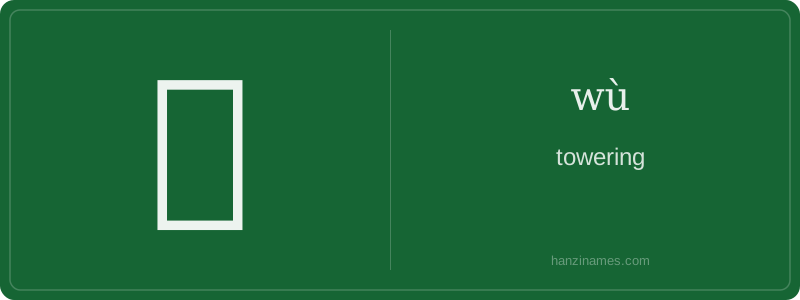
兀 is rarely used independently in contemporary speech but appears in fixed literary expressions and classical allusions. It features prominently in the idiom 兀兀穷年 (wù wù qióng nián), meaning 'to toil tirelessly year after year', where the reduplicated 兀兀 evokes unrelenting, upright perseverance—like a scholar bent over texts, back straight despite exhaustion. It also appears in historical place names and poetic descriptions of terrain, such as in Tang poet Du Fu’s writings referencing barren, towering landforms.
The character’s origin is not pictographic but likely derived from an early variant of 勿 (wù, 'do not'), later repurposed for its phonetic and semantic resonance with height. Its earliest confirmed usage is in bronze inscriptions and the *Shuōwén Jiězì* (121 CE), where Xu Shen defines it as 'high and bare' (高而上平). Today, Chinese learners encounter it mainly in HSK-advanced reading passages or classical literature courses—not in daily conversation, but in contexts demanding rhetorical weight and spatial imagery.
The character 兀 (wù) is a rare but evocative glyph—just three strokes, yet it conveys verticality and imposing presence. Historically, it appears in classical texts to describe cliffs, bare mountain peaks, or solitary, unadorned heights. Its minimalist form mirrors its meaning: no frills, no base—just abrupt elevation. In ancient poetry, 兀 often modifies nouns to intensify their stark, towering quality, like a lone rock jutting from mist-shrouded hills in Huangshan.
Though not part of modern spoken Mandarin, 兀 survives in literary and stylistic contexts where concision and gravitas matter. It’s never used alone in speech, but functions as a prefix or modifier in compound words and idioms—always lending an air of austere grandeur. Think of it as the ‘architectural accent’ of Chinese characters: seldom seen in everyday signage, but unmistakable when it appears on a Song-dynasty scroll or a calligrapher’s inkstone inscription.
Its radical is itself—兀 is both character and radical—a rarity that underscores its foundational, self-contained nature. Unlike pictographs derived from concrete objects, 兀 is ideographic: the stroke order (left-falling stroke, then two horizontal strokes) visually mimics an upward thrust followed by stabilization at height. This structural economy makes it a favorite among advanced learners and calligraphers who appreciate semantic precision wrapped in minimal form.
Example Sentences
Common Compounds
Similar Characters — Don't Mix These Up
Your First Step into Chinese Culture: Get a Chinese Name
Every journey into Chinese begins with a name. Use our free Chinese name generator to create a meaningful, personalized Chinese name that fits you perfectly.
Get My Chinese Name →