兕
Character Story & Explanation
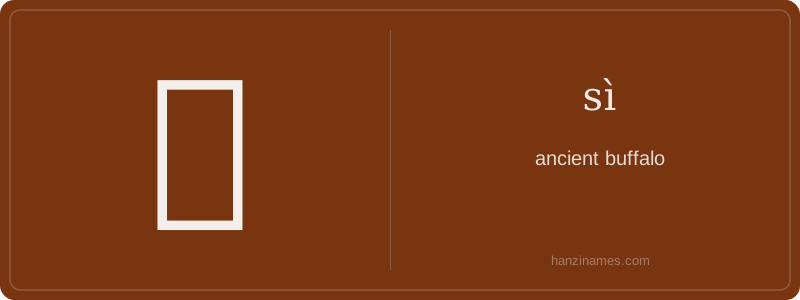
兕 appears almost exclusively in pre-Han and Han dynasty texts, notably in the Shijing (Book of Odes) and Zuo Zhuan, where it denotes a large, horned bovine used in sacrificial rites. It is never attested in modern spoken Mandarin or contemporary media. No idioms (chengyu) contain 兕—it is too rare and archaic. The character survives only in classical quotations, academic sinology, and museum inscriptions on Shang-Zhou bronzes referencing ritual animals.
The character’s earliest attested form is in bronze script (jinwen), where it resembles a stylized profile of a horned bovine head with prominent eyes and curved horns—confirming its pictographic origin. Later seal script simplified the horns and body into the modern structure, retaining the radical 儿 (a phonetic component here, not semantic). There is no verified oracle bone inscription of 兕; its earliest secure appearance is on late Western Zhou bronze vessels.
The Chinese character 兕 (sì) is a rare, archaic term denoting a legendary bovine creature described in pre-Qin texts like the Classic of Poetry and Records of the Grand Historian. Unlike common domestic animals, 兕 was portrayed as powerful, horned, and elusive—often associated with wilderness, sacrifice, or divine omens. Its usage faded after the Han dynasty, surviving primarily in classical allusions and literary rhetoric rather than vernacular speech.
In Western comparative mythology, 兕 bears resemblance to the aurochs (extinct wild ancestor of cattle), the Minoan bull, or even the unicorn in symbolic function—though not in form. While European unicorns signify purity and grace, 兕 connotes raw, untamable natural force and ritual significance. Both serve as cultural shorthand for primordial power, yet 兕 lacks magical attributes; its awe stems from physical might and sacred utility in ancient Zhou dynasty rites.
This character reflects how early Chinese cosmology categorized fauna not just biologically but ritually: 兕 was less a zoological entry than a symbolic vessel—linked to bronze ritual vessels (e.g., ‘si you’ 司兎, though variant forms exist), divination, and elite ceremonial life. Its radical 儿 (ér, 'child' or 'person') is misleading here; it evolved phonetically, not semantically. Modern readers encounter 兕 almost exclusively in scholarly editions, calligraphy practice, or as a stylistic flourish in historical fiction—never in daily conversation.
Example Sentences
Common Compounds
Similar Characters — Don't Mix These Up
Your First Step into Chinese Culture: Get a Chinese Name
Every journey into Chinese begins with a name. Use our free Chinese name generator to create a meaningful, personalized Chinese name that fits you perfectly.
Get My Chinese Name →