兙
Character Story & Explanation
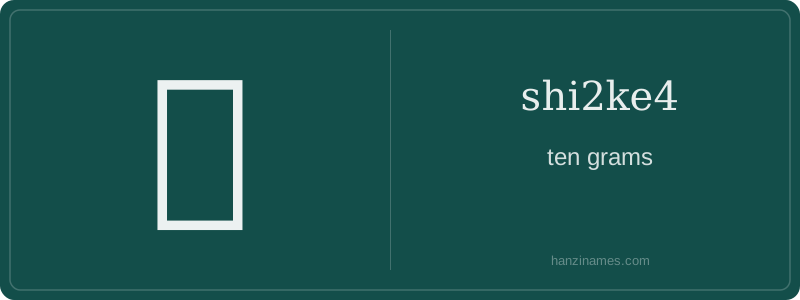
兙 is almost never used in spoken or informal written Chinese. Documented usage appears primarily in mid-20th-century state-issued metrological standards (e.g., GB/T 3100–1993) and early PRC technical manuals where space-saving unit abbreviations were mandated. It appears alongside 兛 (shí kēng, 'ten kilograms') and 兝 (shí gōng, 'ten grams'—note: 兝 is more common than 兙). No idioms, proverbs, or literary works feature 兙; it has zero presence in classical or modern literature.
This character has no pictographic or historical origin—it was artificially designed in the 1950s as a typographic contraction. Its structure combines 十 (top cross) and a simplified lower component derived from 克. Today, Chinese people encounter it only when reading vintage calibration certificates, archival food-safety inspection reports, or advanced HSK 6+ vocabulary lists—not in markets, kitchens, or classrooms.
The character 兙 is a rare, officially recognized metric abbreviation in Chinese—specifically a contracted form of 十克 (shí kè), meaning 'ten grams'. It belongs to a small set of standardized shorthand characters for SI units, introduced by the State Administration for Market Regulation and the National Language Commission to streamline technical and commercial documentation. Though seldom seen in daily handwriting or digital communication, it appears in official metrology documents, pharmaceutical labeling standards, and older industrial specifications.
Unlike common characters with rich historical evolution, 兙 has no ancient origin—it was formally codified in the 1950s–60s during China’s standardization of metric notation. Its design merges elements of 十 (shí, ten) and 克 (kè, gram): the top resembles 十, while the bottom echoes the radical 八 from 克. This intentional fusion reflects its functional role: efficiency in technical writing, not linguistic depth or cultural symbolism.
Because 兙 is obsolete in most modern contexts—even supermarket labels now use '10g' or '十克'—learners are unlikely to encounter it outside specialized fields like metrology law, archival engineering texts, or HSK-level terminology exams. Its inclusion in Unicode (U+5159) and the GB18030 character set affirms its status as a legal variant, but its practical utility remains marginal. Still, recognizing it signals familiarity with China’s systematic approach to language standardization.
Example Sentences
Common Compounds
Similar Characters — Don't Mix These Up
Your First Step into Chinese Culture: Get a Chinese Name
Every journey into Chinese begins with a name. Use our free Chinese name generator to create a meaningful, personalized Chinese name that fits you perfectly.
Get My Chinese Name →