兝
Character Story & Explanation
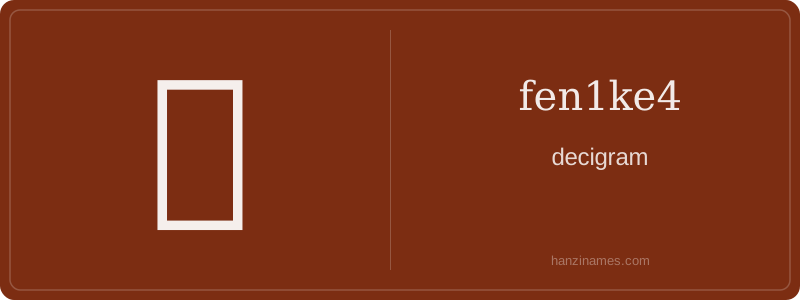
兝 appeared sporadically in early Republican-era (1912–1949) Chinese metrology documents and some 1930s–40s science textbooks as a compact symbol for 'decigram' (0.1 g), intended to mirror Western unit abbreviations like 'dg'. However, it never gained official standardization from the National Bureau of Standards (now SAMR) and vanished from use after the 1959 Metrication Reform, which mandated standardized SI prefixes (毫-, 厘-, 分-) with 克. Today, it appears only in archival scans or academic discussions of historical metrology — never in newspapers, packaging, or digital interfaces.
The character 兝 has no ancient origin or pictographic basis. It’s a modern, artificial fusion: the left side resembles the top of 分 (⺅ + 8), and the right mimics the bottom of 克 (儿 + 丨). But this is purely compositional shorthand — not a true character with etymology. In real life, Chinese people today say '零点一克' or '一百毫克', never '兝'.
Hi students! Let’s talk about the character 兝 — pronounced 'fēn kè' (fen1ke4). This is not a standard Chinese character you’ll find in dictionaries or textbooks. It’s a rare, obsolete contraction meaning 'decigram' (one-tenth of a gram), formed by combining parts of 分 (fēn, 'tenth') and 克 (kè, 'gram'). You’ll almost never see it in modern Mandarin — it was briefly used in early 20th-century scientific or metric contexts but has been fully replaced by standard terms like '0.1 克' or '100 毫克'.
Why does it have zero strokes? Because 兝 is not a hand-writable character with stroke order — it’s a typographic ligature or shorthand symbol, like a unit symbol (e.g., ℃ or ¥), not a true logogram. It doesn’t appear in the Kangxi Dictionary, nor in any HSK list. As learners, you don’t need to write or memorize it — focus instead on the full, clear forms: 分 and 克.
This character illustrates an important lesson: Chinese writing evolves. Some abbreviations emerge in technical fields but fade when clearer alternatives dominate. Think of 兝 like a historical footnote — interesting for linguists, but irrelevant for daily communication or exams. Your energy is better spent mastering high-frequency characters like 克 (gram), 千克 (kilogram), or 毫克 (milligram) — all of which *are* in HSK and used daily.
Example Sentences
Common Compounds
Similar Characters — Don't Mix These Up
Your First Step into Chinese Culture: Get a Chinese Name
Every journey into Chinese begins with a name. Use our free Chinese name generator to create a meaningful, personalized Chinese name that fits you perfectly.
Get My Chinese Name →