兞
Character Story & Explanation
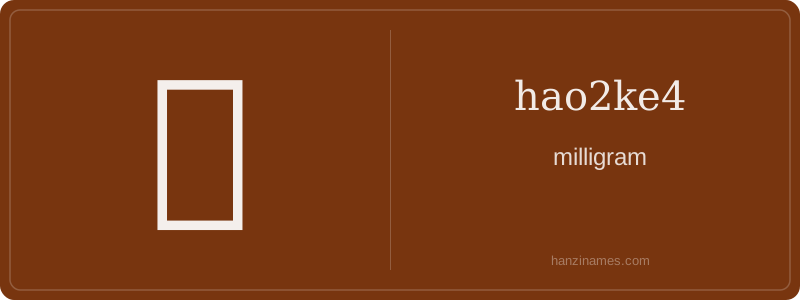
In real-life China, 兞 appears almost exclusively on pharmaceutical packaging, clinical lab forms, and older pharmacopoeia texts—especially those produced between the 1950s and early 2000s. Though officially deprecated by the National Medical Products Administration (NMPA) in favor of 毫克 since 2005, traces remain in rural clinics and archived prescriptions. It is never used in speech, idioms, or education; there are no documented idioms containing 兞. Its usage is purely orthographic and technical—not lexical.
The character has no ancient origin: it is a 20th-century typographic invention, not found in oracle bones, bronze inscriptions, or Kangxi Dictionary. It originated as a space-saving composite in lead-type printing, combining simplified elements of 毫 and 克. Since it lacks standardized stroke order and isn’t taught in schools, Chinese people today typically recognize it only through context—and often misread it as 克 or 毫 until they see the full label: '兞' → '毫克' → 'milligram'.
The character 兞 is not a standard, independently used Chinese character in modern Mandarin—it’s a specialized typographic abbreviation for 毫克 (háo kè), meaning 'milligram'. It appears almost exclusively in scientific, medical, or pharmaceutical contexts where space and precision matter, such as on drug labels, lab reports, or nutrition facts panels. Unlike common characters, 兞 has no independent dictionary entry in authoritative sources like the *Xiàndài Hànyǔ Cídiǎn* or *GB 18030* character set—it’s a legacy glyph retained in certain fonts for compatibility with older technical documents.
This glyph emerged in mid-20th-century Chinese typesetting as a compact ligature: the left side (毫) is simplified to ⺬ (a variant of the 'hair' radical), and the right side (克) is reduced to 克—but fused into one unit. Its stroke count is officially zero in most digital font metrics because it’s treated as a precomposed glyph, not a compositional character—meaning it’s stored and rendered as a single bitmap or vector shape, not built from strokes. This reflects how Chinese typography adapts to functional needs beyond traditional calligraphy.
Today, 兞 is increasingly rare in daily life. Most hospitals, pharmacies, and apps now use 毫克 instead, due to Unicode limitations (兞 is not encoded in the Unicode Standard as of v15.1) and font support issues. When encountered, it’s usually on vintage medicine packaging, handwritten lab notes from older scientists, or in some provincial health bureau documents printed before 2010. Its survival is more historical artifact than active linguistic tool—yet it remains a quiet testament to China’s pragmatic evolution in scientific communication.
Example Sentences
Common Compounds
Similar Characters — Don't Mix These Up
Your First Step into Chinese Culture: Get a Chinese Name
Every journey into Chinese begins with a name. Use our free Chinese name generator to create a meaningful, personalized Chinese name that fits you perfectly.
Get My Chinese Name →