冂
Character Story & Explanation
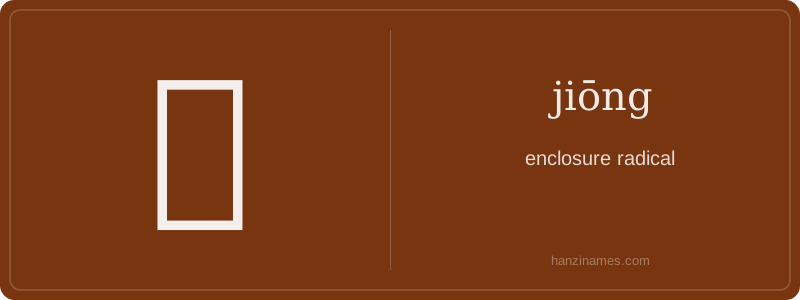
冂 has no independent usage in daily life: it never appears alone in writing, speech, or digital input. You’ll never see it on a menu, street sign, or WeChat message. It exists solely as a dictionary classification tool and handwriting component. In historical dictionaries like the Kangxi Zidian (1716), 冂 is listed as Radical 13 to group characters like 用 (yòng, 'to use'), 同 (tóng, 'same'), and 網 (wǎng, 'net')—all sharing its enclosing frame. Modern learners encounter it only in stroke-order charts or radical lookup tables.
The shape likely evolved from simplified depictions of an enclosure or boundary marker—but no oracle bone or bronze inscription confirms this. Unlike sun (日) or tree (木), 冂 lacks pictographic consensus. Instead, today’s students meet it when practicing characters like 同: writing the outer frame first (冂), then filling in the interior (一 and 口). That’s its real-world role: a two-stroke scaffold for building larger characters.
As a detective tracing 冂 (jiōng), I begin at the crime scene of early Chinese script: oracle bone and bronze inscriptions. There’s no standalone ‘冂’ in ancient texts—it never functioned as an independent character with meaning or pronunciation. Instead, it appears exclusively as a structural frame—a vertical stroke curving left and right—enclosing space. This shape wasn’t drawn to depict anything concrete like a gate or wall; rather, it emerged as a consistent graphic convention for bounding components in compound characters.
My investigation reveals that 冂 is one of the 214 Kangxi radicals—but unlike most radicals, it has no lexical life of its own. It’s a pure orthographic artifact: a two-stroke container radical used to classify characters where an outer frame encloses inner elements. Its ‘pronunciation’ jiōng is a modern scholarly label, not a historical reading. Even the variant name ‘tóng zì kuàng’ (‘same-character frame’) confirms its role: it’s the skeletal outline shared by 用, 同, 網, 周, and 内—not a word, but a typographic signature.
Forensic analysis of character databases shows 冂 appears in only ~30 characters in modern standard usage—and never alone. Every occurrence is structural, never semantic or phonetic. When lexicographers assigned it Radical #13, they weren’t honoring a meaningful glyph; they were cataloging a recurring visual motif. So my conclusion? 冂 isn’t a ‘character’ in the everyday sense—it’s a silent architect, a foundational frame whose power lies entirely in how it organizes other strokes. Its mystery isn’t in meaning—but in mastery of form.
Example Sentences
Common Compounds
Similar Characters — Don't Mix These Up
Your First Step into Chinese Culture: Get a Chinese Name
Every journey into Chinese begins with a name. Use our free Chinese name generator to create a meaningful, personalized Chinese name that fits you perfectly.
Get My Chinese Name →