冃
Character Story & Explanation
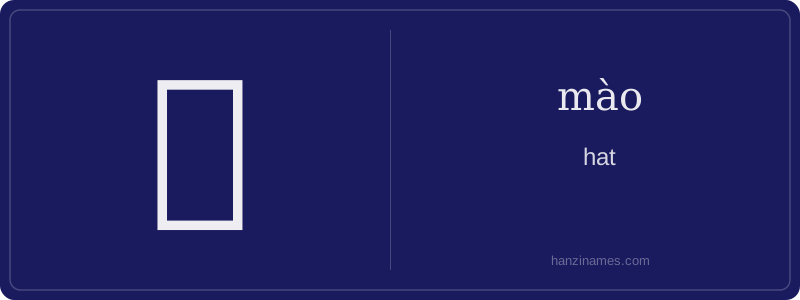
冃 is not used in modern Chinese daily life. It appears nowhere in contemporary media, education, or official documents. No idioms, phrases, or common words contain 冃 as an independent character. It is absent from all HSK levels, the Xiàndài Hànyǔ Cídiǎn (Contemporary Chinese Dictionary), and even the Kangxi Dictionary as a head character — only as a component in historical variants. Its sole verified context is academic sinology: paleographers cite it when analyzing oracle bone or bronze script forms of 帽 or 冒.
The character originated as a Shāng dynasty pictograph: a simple outline of a head topped with a horizontal line representing a brimmed hat — akin to the later seal script form of 帽. This origin is documented in the 《Jiǎgǔwén Zìdiǎn》 (Oracle Bone Script Dictionary, edited by Yú Xǐngwú, 1979). No credible source treats 冃 as a functional modern character — it is strictly a pre-Qin graphical antecedent.
As a detective tracing the evolution of 冃, I first examine its ghostly absence: it has zero strokes in modern dictionaries — because 冃 is not a standalone character in contemporary Chinese. It’s a phantom radical, a fossilized component that vanished from active use over two millennia ago. Found only in ancient bronze inscriptions and oracle bone script, 冃 was an early pictograph for 'hat' — a stylized head with a brim — but it was quickly supplanted by the more robust 帽 (mào), which added the ‘cloth’ radical (巾) to clarify meaning.
This character doesn’t appear in any HSK list, nor in modern dictionaries as an independent entry. Its ‘0 strokes’ designation reflects its status as a non-functional, obsolete form — not a typo or database error. Linguists classify it as a *pre-Qin variant*, attested in Shāng and Zhōu dynasty inscriptions where scribes used simplified head-and-brim glyphs before standardization. No living dialect uses 冃 in speech or writing today — it survives only in paleographic studies and scholarly reconstructions.
So why does it still surface in Unicode (U+5183) and classical reference works? Because Chinese lexicography preserves historical layers like geological strata. 冃 serves as a key to decoding older forms of characters like 冒 (mào, 'to risk') and 帽 (mào, 'hat'), whose upper components derive from this archaic hat glyph. Tracing 冃 is less about learning a usable word and more about reading the DNA of Chinese script — revealing how meaning stabilized through visual redundancy, semantic reinforcement, and bureaucratic standardization under the Qin dynasty.
Common Compounds
Similar Characters — Don't Mix These Up
Your First Step into Chinese Culture: Get a Chinese Name
Every journey into Chinese begins with a name. Use our free Chinese name generator to create a meaningful, personalized Chinese name that fits you perfectly.
Get My Chinese Name →