円
Character Story & Explanation
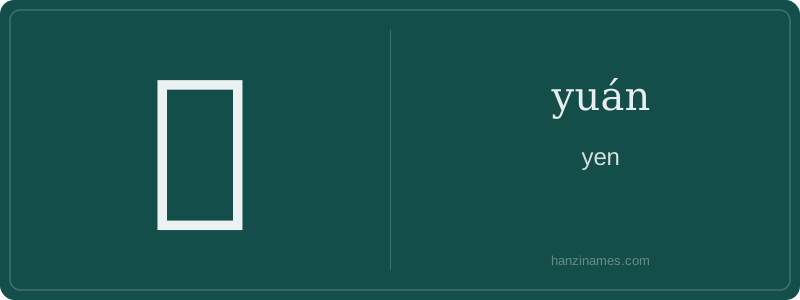
In contemporary mainland China, the character 円 is virtually unused in daily life. It does not appear in textbooks, financial documents, media, or official publications. When encountered, it is almost always in Japanese-language contexts—such as imported Japanese product labels, anime subtitles, or bilingual travel guides. No idioms, set phrases, or historical Chinese texts use 円; the classical and modern standard forms are 圆 (simplified) and 圓 (traditional), both meaning 'circle' or 'round'.
The character 円 originated in Japan as a shinjitai (new character form) simplification of 圓, officially adopted in 1946 under the *Tōyō Kanji* list. It preserves the outer 'box' radical 冂 (jiōng, 'downward enclosure') but replaces the inner components with a single dot and horizontal stroke—reflecting practical handwriting reduction, not semantic evolution. This simplification has no counterpart in Chinese orthography.
The character 円 is not a native Chinese character—it is the Japanese simplified form of the traditional Chinese character 圓 (yuán), meaning 'circle' or 'round'. In modern Chinese, 円 is rarely used and holds no standard meaning; it is not included in the People’s Republic of China’s standardized character set (GB 2312, GB 18030) nor in the HSK vocabulary lists. Its presence in Chinese contexts is almost exclusively limited to Japanese loanwords, historical documents referencing pre-1949 Japanese occupation zones, or specialized typographic contexts (e.g., bilingual signage).
While 円 is pronounced yuán in Mandarin, this reading is purely phonetic borrowing—Chinese speakers do not associate it with currency. In Japan, 円 is the official kanji for 'yen', the national currency, derived from 圓 (meaning 'round coin') due to the circular shape of Edo-period silver coins. Unlike the Chinese yuan (¥), which uses the character 元 (also pronounced yuán), the Japanese yen uses 円 as its legal written form—a distinction rooted in Japan’s 1946 character simplification reforms.
This character illustrates how shared Sinitic script traditions diverged: China adopted 元 for its currency unit (since the Yuan dynasty), while Japan retained and simplified 圓 → 円. For learners, confusing 円 with Chinese 元 or 圆 is a common pitfall. Crucially, 円 appears in no HSK-level materials, has no stroke order taught in mainland Chinese schools, and is absent from authoritative dictionaries like the *Xiandai Hanyu Cidian*. Its relevance for Chinese learners is purely comparative—not functional.
Example Sentences
Common Compounds
Similar Characters — Don't Mix These Up
Your First Step into Chinese Culture: Get a Chinese Name
Every journey into Chinese begins with a name. Use our free Chinese name generator to create a meaningful, personalized Chinese name that fits you perfectly.
Get My Chinese Name →