冇
Character Story & Explanation
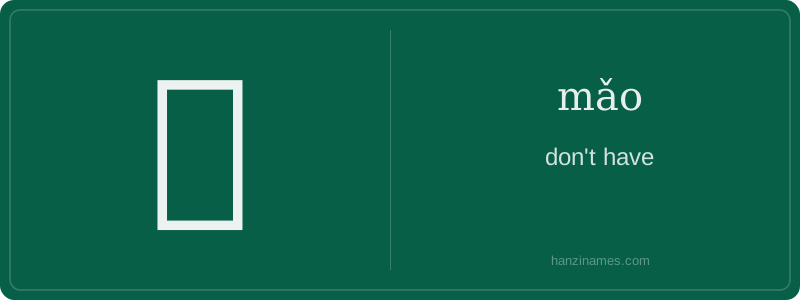
冇 is widely used in spoken and informal written Cantonese across Guangdong, Hong Kong, and Macau. It appears in everyday phrases like '我冇钱' (ngo5 mou5 cin2, 'I don’t have money') and is common in film subtitles, WhatsApp messages, and local signage. It’s absent from formal documents, news broadcasts, and school curricula in mainland China—but taught in some Hong Kong primary schools as part of local language preservation efforts.
The character 冇 is a regional simplification of the classical 无 (wú), adapted in Southern Song–Yuan dynasty vernacular texts. Its modern form (冇) first appeared reliably in Ming dynasty Cantonese opera scripts and Qing-era bamboo slips from Guangzhou. It is *not* a pictograph or oracle-bone relic—it’s a phonetic-semantic reduction: the top '丿' and '一' suggest 'lack', while the bottom '有' (yǒu, 'to have') is kept ironically intact to emphasize negation through visual contrast.
冇 (mǎo) is not a standard Mandarin character—it’s a Cantonese-specific written form meaning 'to not have'. Unlike Mandarin’s 没 (méi), which is used nationwide, 冇 appears almost exclusively in Cantonese speech and informal writing, such as social media posts, subtitles for粤语 TV dramas, or handwritten notes in Guangdong and Hong Kong. It carries no official HSK level because it’s excluded from mainland China’s standardized curriculum and simplified character lists.
This character reflects linguistic divergence within Chinese: while Mandarin uses 没有 (méiyǒu) for negation of possession, Cantonese speakers say ‘mou5’ (Jyutping) and write 冇. Its shape—originally a variant of the archaic character 无 (wú, 'without')—was simplified in southern folk script to avoid confusion with 没. Though absent from formal education, 冇 is deeply embedded in regional identity and daily oral communication.
Importantly, 冇 has zero strokes in standard stroke-counting systems because it is *not recognized* in the People’s Republic of China’s official character set (GB2312, GB18030). It’s absent from Unicode’s CJK Unified Ideographs until Unicode 3.0 (2001), where it was added as U+5196—but only as a Cantonese variant. This means most mainland input methods don’t support it by default, and learners studying Mandarin won’t encounter it in textbooks.
Example Sentences
Common Compounds
Similar Characters — Don't Mix These Up
Your First Step into Chinese Culture: Get a Chinese Name
Every journey into Chinese begins with a name. Use our free Chinese name generator to create a meaningful, personalized Chinese name that fits you perfectly.
Get My Chinese Name →