冉
Character Story & Explanation
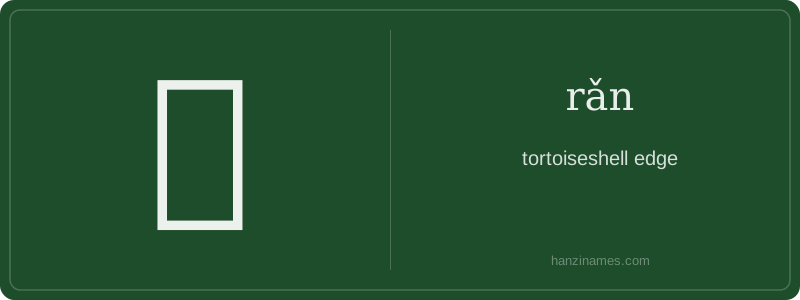
冉 is most commonly encountered today as a surname (e.g., Confucius’ disciple Ran Geng, known as Ran Boniu), and appears in classical texts like the Analects and Zuo Zhuan. It survives in literary compounds such as 冉冉 (rǎnrǎn), meaning 'gradually, softly rising' — used in poetry to describe drifting smoke, blossoming flowers, or rising fame. The phrase 冉冉升起 (rǎnrǎn shēngqǐ) — 'rising slowly and steadily' — remains standard in formal news reports and speeches, especially about national development or dawn imagery.
The character’s earliest form (in bronze inscriptions) resembles two parallel, curving lines descending from a horizontal top — likely stylized depiction of the tapered, overlapping edges of turtle plastron segments. Unlike many pictographs, it wasn’t a direct drawing of a shell, but an abstracted representation of its distinctive rim geometry — confirmed by paleographic studies of Shang-Zhou ritual bronzes.
Hi students! Let’s explore 冉 (rǎn), a small but elegant character with just five strokes. Though it looks simple, it carries an ancient meaning: 'edge of a tortoiseshell' — referring to the smooth, curved rim used in early Chinese divination rituals. In classical texts, this shape symbolized gradual, gentle movement — like steam rising or hair growing slowly. That’s why 冉 later developed meanings related to ‘gradually’ or ‘gently’, especially in literary or poetic contexts.
Don’t confuse 冉 with more common adverbs like 慢慢 (mànmàn) — 冉 is rare in spoken Mandarin today, appearing mostly in formal writing, names, and set phrases. Its radical 冂 (jiōng) — meaning 'downward enclosure' — hints at its original pictographic link to a curved, enclosing edge. As you practice writing it, notice how each stroke flows downward and inward, echoing that shell-like contour.
As a beginner, focus first on recognizing 冉 in names (e.g., the surname Rǎn) and classical idioms. It won’t appear in HSK 1–4 exams, but knowing it enriches your understanding of Chinese etymology and poetic diction. Think of it as a quiet ‘cultural artifact’ — not essential for daily talk, but meaningful when you see it in poetry, calligraphy, or historical dramas.
Example Sentences
Common Compounds
Similar Characters — Don't Mix These Up
Your First Step into Chinese Culture: Get a Chinese Name
Every journey into Chinese begins with a name. Use our free Chinese name generator to create a meaningful, personalized Chinese name that fits you perfectly.
Get My Chinese Name →