冖
Character Story & Explanation
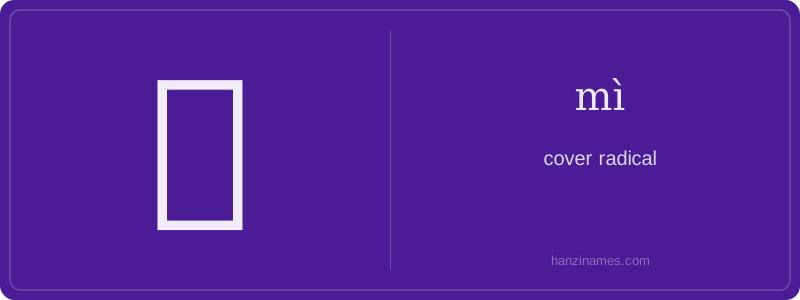
冖 is never used independently in modern Mandarin; it functions exclusively as a radical — most famously appearing atop 軍 (jūn, 'army'), where it historically signified the commander’s canopy or banner symbolizing command authority. It also appears in characters like 冠 (guān, 'crown') and 冥 (míng, 'dark, obscure'), reinforcing its association with covering or enveloping. No idioms use 冖 alone, but its presence is indispensable in thousands of compound characters.
The form of 冖 derives from ancient script forms representing a cloth or canopy draped over a person or object. Oracle bone and bronze inscriptions show variants resembling a bent line over a figure — a pictographic origin confirmed by paleographers such as Qiu Xigui. Its two-stroke modern shape is a highly stylized simplification of that early pictograph.
冖 (mì) is not a standalone character used in modern speech or writing, but a fundamental structural component — the 'cover' or 'canopy' radical. It appears at the top of many Chinese characters to suggest enclosure, protection, or covering, much like a roof over a space. Though rarely seen alone, its presence shapes meaning and pronunciation in dozens of common characters, especially those related to authority, containment, or concealment.
This radical is formally named 禿寶蓋 (tū bǎo gài), meaning 'bald treasure cover', referencing its simplified, stroke-minimal form compared to the fuller 宀 (mián) radical ('roof'). Unlike 宀, 冖 lacks the leftward hook, giving it a flatter, more abstract appearance. Its two-stroke simplicity makes it one of the earliest radicals learners encounter in character analysis — essential for understanding how meaning is visually encoded.
In Western typographic or symbolic terms, 冖 resembles a minimalist architectural arch or an inverted 'U' — evoking concepts like shelter, oversight, or hierarchy. While no direct English letter equivalent exists, its functional role parallels Latin prefixes like 'sub-' (under) or 'super-' (over), but with a visual, top-down semantic force. It’s less about sound and more about spatial metaphor: something overarching, governing, or concealing — a silent yet powerful design principle in written Chinese.
Example Sentences
Common Compounds
Similar Characters — Don't Mix These Up
Your First Step into Chinese Culture: Get a Chinese Name
Every journey into Chinese begins with a name. Use our free Chinese name generator to create a meaningful, personalized Chinese name that fits you perfectly.
Get My Chinese Name →