冗
Character Story & Explanation
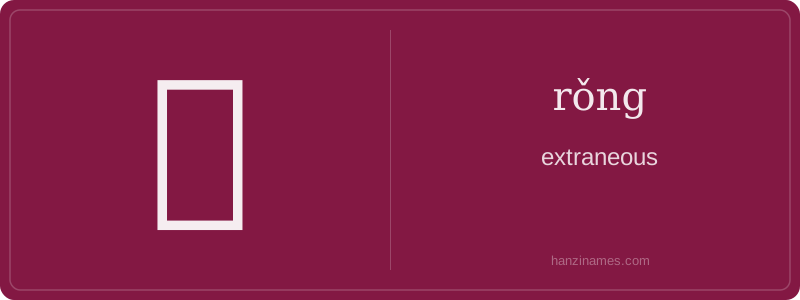
冗 is widely used in modern Standard Chinese in technical, bureaucratic, and editorial contexts — notably in computing (e.g., 冗余 backup = 'redundant backup'), linguistics (冗余信息 = 'redundant information'), and government documents criticizing inefficiency. A well-documented phrase is 冗官冗兵 (rǒngguān rǒngbīng), historically referring to bloated civil and military bureaucracies during the Ming and Qing dynasties — cited in imperial memorials and modern historical scholarship.
The character’s earliest attested form appears in seal script (c. 3rd century BCE), where it combines 冖 (a covering) and 人 (person) — suggesting someone ‘covered over’ or ‘unnecessarily present’. While not pictographic like 日 or 月, this structure reflects its semantic logic: superfluous presence under a surface or system.
Hi students! Let’s look at the character 冗 (rǒng). It’s a simple but meaningful character — only four strokes, and its radical is 冖 (the 'cover' radical), which often hints at something covering or overlaying. Think of it as representing unnecessary things piled on top — like extra words in a sentence or unneeded steps in a process. Though small, it carries a precise, critical idea: ‘extraneous’ or ‘superfluous’.
This character doesn’t stand alone in speech — you’ll almost never hear it used by itself in conversation. Instead, it appears in formal written Chinese, especially in academic, administrative, or editing contexts. It’s a ‘thinking word’: it helps writers and editors identify what to cut for clarity and concision. Its tone (third tone) is important — say it with a falling-then-rising pitch: rǒng, like asking ‘huh?’ but more deliberate.
Because 冗 is rarely used alone, learning it is most effective when paired with common compounds like 冗长 (rǒngcháng, ‘tediously long’) or 冗余 (rǒngyú, ‘redundancy’). These appear regularly in newspapers, software documentation, and official documents. Mastering 冗 helps you read critically — spotting fluff, trimming excess, and appreciating Chinese values of precision and elegance in expression.
Example Sentences
Common Compounds
Similar Characters — Don't Mix These Up
Your First Step into Chinese Culture: Get a Chinese Name
Every journey into Chinese begins with a name. Use our free Chinese name generator to create a meaningful, personalized Chinese name that fits you perfectly.
Get My Chinese Name →