冢
Character Story & Explanation
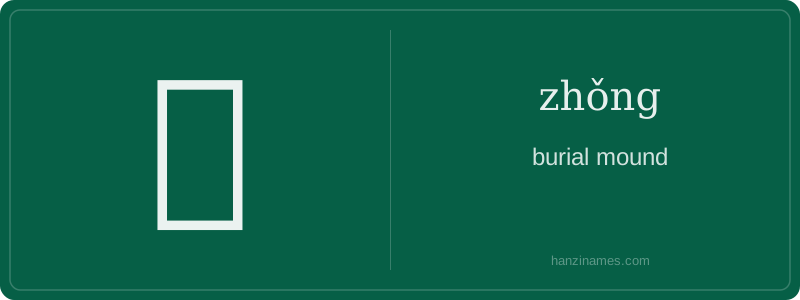
冢 appears most frequently in literary, historical, and formal contexts—not daily speech. It survives in classical compounds like ‘古冢’ (gǔ zhǒng, ancient mound/tomb) and ‘荒冢’ (huāng zhǒng, desolate tomb), often evoking melancholy or historical reflection in poetry and prose. It’s also found in place names (e.g., Zhongnan Mountain’s ‘Lingzhong’—spirit mound) and official archaeological reports describing Han- or Tang-dynasty burial mounds. Modern usage is largely restricted to written registers, never colloquial speech.
The character’s earliest attested form appears in bronze inscriptions of the late Zhou dynasty (c. 5th century BCE), where it depicts a raised earthen structure covered by a roof-like element (冖), confirming its original association with constructed, ritualized burial mounds—not natural hills. The lower part evolved from 丰 (abundance), signifying a mound that sustains ancestral veneration.
冢 (zhǒng) is far more than a simple 'mound'—it embodies the Chinese worldview that land, memory, and lineage are inseparable. In classical thought, a mound marks where human presence converges with cosmic order: ancestral spirits rest beneath it, geomancers (feng shui masters) assess its qi flow, and historians read dynastic rise and fall in the erosion of imperial tumuli. This character reflects a reverence for verticality—not just elevation, but hierarchy, continuity, and quiet dignity in stillness.
The radical 冖 (mì), meaning 'cover' or 'canopy', frames the character like a ritual veil—suggesting concealment, sanctity, and protection. Beneath it lies 丰 (fēng), originally depicting abundant grain sheaves, later simplified to two horizontal strokes and a vertical. Together, they evoke a covered abundance: not barren earth, but fertile ground consecrated by memory. This duality—concealment + fertility—mirrors Confucian ideals of respectful remembrance nurturing moral harvest.
In Daoist and folk cosmology, mounds are liminal thresholds: neither fully earthly nor celestial, they anchor spirits between realms. Unlike Western tombs emphasizing individual eternity, 冢 emphasizes relational permanence—the mound persists because descendants return, sweep, offer incense, and speak names aloud. Its ten strokes trace a slow, deliberate descent from sky (冖) to soil (the lower structure), mirroring the ritual act of burial itself: a gentle, reverent settling into time’s deep layers.
Example Sentences
Common Compounds
Similar Characters — Don't Mix These Up
Your First Step into Chinese Culture: Get a Chinese Name
Every journey into Chinese begins with a name. Use our free Chinese name generator to create a meaningful, personalized Chinese name that fits you perfectly.
Get My Chinese Name →