冥
Character Story & Explanation
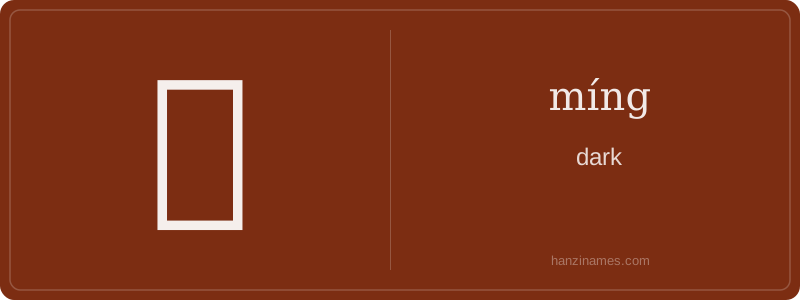
In modern Chinese, 冥 appears most frequently in religious, literary, and bureaucratic contexts—not daily speech. It’s central to terms like 冥想 (míngxiǎng, 'meditation') and 冥府 (míngfǔ, 'netherworld'), and features in official documents for Buddhist/Taoist temple registrations. The idiom 冥思苦想 (míngsī kǔxiǎng, 'to rack one’s brains') remains common in education and media, reflecting deep, absorbed thought. Historically, it appears in Tang dynasty poetry and Ming legal codes concerning afterlife rituals.
The character’s seal script origin shows 冖 (covering) over 日 (sun), visually encoding 'concealed sun'. While oracle bone inscriptions lack 冥, its earliest attested form is in Warring States bamboo texts—confirming its association with spiritual depth rather than literal darkness. Today, Chinese learners encounter it first in HSK 5+ vocabulary, often via meditation apps or classical literature.
As an archaeologist brushing dust from a Han dynasty bamboo slip, I find 冥 not as mere 'darkness', but as a semantic stratum revealing ancient cosmology: the veil between realms. Its radical 冖 (a covering) over 日 (sun) and 六 (a phonetic variant of 亦, later simplified) suggests concealment—not absence—of light. This isn’t just night; it’s the profound, reverent dimness of ancestral tombs and spirit tablets, where visibility yields to intuition.
Excavations at Mawangdui unearthed texts where 冥 governs spiritual navigation: 冥界 (the netherworld) wasn’t feared, but ritually mapped. The character appears in early Daoist talismans inscribed on jade—its ten strokes deliberately balanced to harmonize yin energy. Unlike Western binaries of light/dark, 冥 embodies generative obscurity: the fertile void before creation, echoed in the Daodejing’s 'mysterious mystery' (玄之又玄).
Modern paleography confirms 冥 evolved from seal script forms where the ‘sun’ component was partially obscured by the covering radical—literally visualizing occlusion. Its consistency across 2,200 years testifies to cultural continuity: today’s funeral rites still use 冥钱 (spirit money), linking Bronze Age tomb practices with contemporary ancestor veneration. This character is less a word than a time capsule sealed in ink and ritual.
Example Sentences
Common Compounds
Similar Characters — Don't Mix These Up
Your First Step into Chinese Culture: Get a Chinese Name
Every journey into Chinese begins with a name. Use our free Chinese name generator to create a meaningful, personalized Chinese name that fits you perfectly.
Get My Chinese Name →