冧
Character Story & Explanation
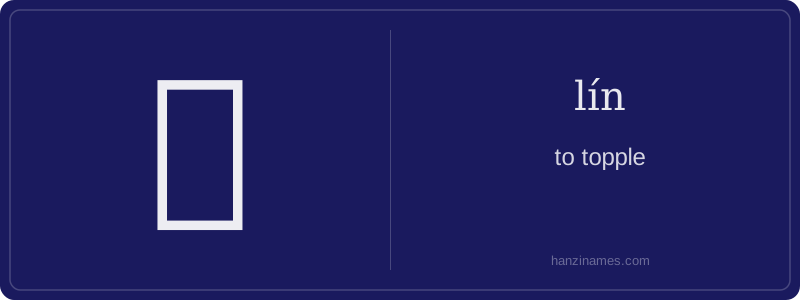
冧 is primarily used in Cantonese-language contexts—especially in Hong Kong media, safety signage, and engineering reports—to denote sudden structural collapse (e.g., ‘棚架冧咗’ – ‘the scaffolding collapsed’). It appears in official documents like the Hong Kong Construction Sites (Safety) Regulations and is listed in the Hong Kong Supplementary Character Set (HKSCS), first added in HKSCS-2004. It is absent from mainland China’s standard character sets and rarely taught in Mandarin-focused curricula.
The character is a phono-semantic compound: the top radical 冖 (mì, ‘cover’) hints at downward pressure or enclosure, while the bottom 林 (lín, ‘forest’) serves phonetically (both read lín) and evokes multiple upright objects falling together—like trees or columns. No oracle-bone or seal-script ancestor exists; it is a modern creation, attested earliest in mid-20th-century Hong Kong printed materials.
The character 冧 (lín) is a rare, non-standard Chinese character—absent from the modern GB2312, GB18030, and Unicode Basic Multilingual Plane until very recently (Unicode 13.0, 2020). Its inclusion reflects how Chinese orthography evolves to capture regional linguistic reality, especially Cantonese usage. Unlike classical characters rooted in ancient texts, 冧 emerged organically from spoken language, embodying a pragmatic, bottom-up approach to writing: when speech demands representation, script adapts—even if it means adding a new glyph.
This character offers a window into the pluralistic nature of Chinese writing culture. Standard Mandarin orthography prioritizes historical continuity and national unification, but Cantonese-speaking communities—especially in Hong Kong and Guangdong—have long needed characters for vernacular verbs like 'to topple' or 'to collapse suddenly'. 冧 fills that lexical gap, revealing how language lives not just in dictionaries, but in markets, construction sites, and emergency reports where things literally come crashing down.
Its minimalist structure—two components stacked (冖 + 林)—mirrors its semantic urgency: a covering (冖, 'cover') over a forest (林, 'trees') suggests sudden, overwhelming collapse, like trees toppling under a collapsing roof. Though not philosophically layered like Daoist or Confucian ideographs, 冧 carries cultural weight as a testament to linguistic resilience—the quiet insistence that everyday experience, even disaster, deserves its own written form.
Example Sentences
Common Compounds
Similar Characters — Don't Mix These Up
Your First Step into Chinese Culture: Get a Chinese Name
Every journey into Chinese begins with a name. Use our free Chinese name generator to create a meaningful, personalized Chinese name that fits you perfectly.
Get My Chinese Name →