凅
Character Story & Explanation
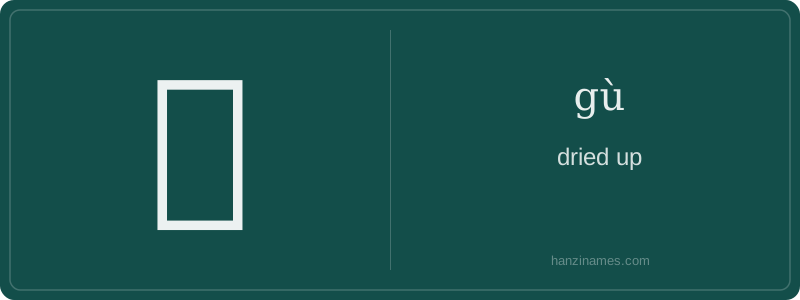
凅 is primarily used in written, literary, or technical contexts — especially in ecology, hydrology, and classical literature. You’ll find it in phrases like 河流干凅 (héliú gān gù), meaning 'a river has dried up completely', often in news reports about droughts in northern China. It also appears in the idiom 山穷水凅 (shān qióng shuǐ gù), a variant of the more common 山穷水尽 (shān qióng shuǐ jìn), both meaning 'at the end of one’s resources'. The character is documented in modern dictionaries (e.g.,《现代汉语词典》7th ed.) as a variant for 干涸 (gān hé), with identical meaning but higher stylistic formality.
The character is a phono-semantic compound: left side 氵(water radical) indicates meaning; right side 固 (gù) provides pronunciation and reinforces the idea of 'fixity' — water no longer flowing, thus 'set in dryness'. No oracle bone or bronze script forms survive; it first appears in late imperial texts as a refined alternative to 干涸.
Hello students! Today we’ll explore the character 凅 (gù), which means 'dried up' — like a riverbed after a long drought or cracked earth in summer. It’s a relatively rare but vivid character, often used in literary or formal contexts rather than daily chat. Though not common in spoken Mandarin, it appears in classical poetry, environmental writing, and idiomatic expressions to evoke desolation or depletion.
This character belongs to the ‘water’ radical group (氵), confirming its connection to liquid states and their absence. Its right side, 固 (gù), means 'solid', 'firm', or 'fixed' — so 凅 literally suggests water that has become solid/fixed — i.e., evaporated or vanished entirely. That semantic logic helps learners remember both form and meaning.
Don’t worry if you haven’t seen this character before — it’s absent from the HSK syllabus (not in HSK 1–6) and rarely appears in beginner textbooks. But mastering it deepens your appreciation of how Chinese characters encode natural phenomena through elegant, logical composition. Think of it as a poetic 'stop sign' for moisture!
Example Sentences
Common Compounds
Similar Characters — Don't Mix These Up
Your First Step into Chinese Culture: Get a Chinese Name
Every journey into Chinese begins with a name. Use our free Chinese name generator to create a meaningful, personalized Chinese name that fits you perfectly.
Get My Chinese Name →