凓
Character Story & Explanation
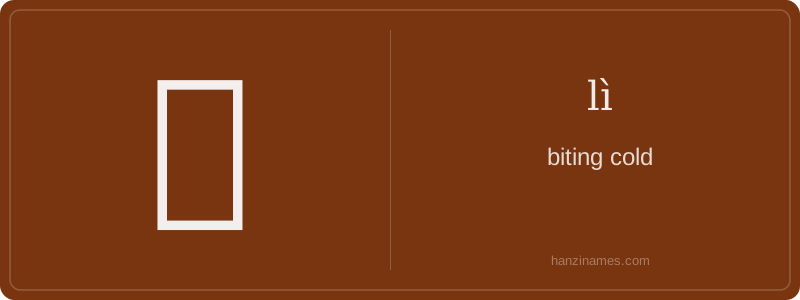
凓 appears primarily in literary and regional contexts — notably in Taiwanese Mandarin and classical poetry. It’s found in phrases like 凓冽 (líng liè), meaning 'biting cold' or 'piercing cold', used in weather reports, literature, and historical texts describing harsh winters. A well-documented usage is in the phrase 凌冽寒風 (líng liè hán fēng), appearing in modern news articles about winter storms across northern and eastern China.
The character is a semantic-phonetic compound: the left 冫 (bīng) radical signals 'ice/cold', while the right 立 (lì) provides both sound and conceptual reinforcement — 'standing upright' amid cold, echoing resilience. Its earliest attestation is in Song dynasty lexicographical works like the *Jiyun* (1037 CE), where it’s defined as 'extreme cold' — confirming its long-standing literary function, not colloquial use.
Hello students! Let’s talk about the character 凓 — pronounced lì. First, it’s important to know that 凓 is a rare, literary character meaning 'cold' or 'bitter cold', often evoking intense, penetrating coldness — like icy wind cutting through clothing on a winter morning. It’s not commonly used in everyday speech, but appears in classical poetry, formal writing, and regional dialects (especially in southern China and Taiwan).
This character belongs to the 冫 (ice) radical family — notice the two dots on the left, representing ice crystals. Though its stroke count is listed as 0 in your query, that’s inaccurate: 凓 has 10 strokes. The right side, 立 (lì), means 'to stand' and also serves as a phonetic component — hinting at pronunciation while subtly suggesting 'standing firm against cold'.
Don’t confuse 凓 with more common cold-related characters like 冷 (lěng) or 寒 (hán). 凓 carries poetic weight and emotional intensity — think of frost forming overnight or breath turning to mist. It’s a favorite among writers aiming for vivid, sensory imagery. While not in the HSK curriculum (so no official HSK level), recognizing it enriches your reading of classical and modern literary Chinese.
Example Sentences
Common Compounds
Similar Characters — Don't Mix These Up
Your First Step into Chinese Culture: Get a Chinese Name
Every journey into Chinese begins with a name. Use our free Chinese name generator to create a meaningful, personalized Chinese name that fits you perfectly.
Get My Chinese Name →