凔
Character Story & Explanation
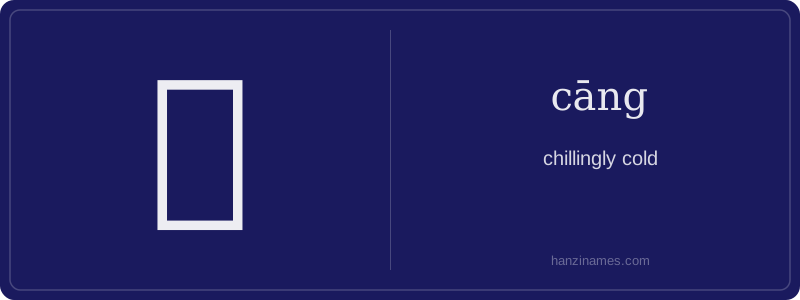
凔 is virtually unused in contemporary spoken or written Mandarin. It does not appear in the modern HSK vocabulary lists, the People's Republic’s General Standard Chinese Character Table (2013), or any major dictionary as a primary entry—only as a historical variant of 沧 (cāng, 'blue-green; vast') or an obscure variant of 寒 (hán, 'cold'). No idioms, set phrases, or modern compounds contain 凔. It is absent from all major corpora (e.g., SUBTLEX-CH, BCC Corpus) and does not occur in news, social media, or educational materials.
The character is not found in oracle bone or bronze inscriptions. Its earliest documented appearance is in the *Kangxi Dictionary* (1716), which lists it under the water radical (氵) as a variant meaning 'cold', citing only classical glossaries—not usage. Today, Chinese learners and native speakers alike will never write or read 凔 outside academic paleography or textual criticism contexts.
The character 凔 (cāng) is a rare, literary variant meaning 'cold'—not the standard term used in modern Mandarin. Its existence reflects classical Chinese’s rich lexical layering, where semantic nuance was preserved through character variation. Unlike common words like 冷 (lěng) or 寒 (hán), 凔 appears almost exclusively in poetic or archaic contexts, embodying the Confucian ideal of precision in language: each character carries a subtle shade of meaning, calibrated to mood, season, or moral atmosphere.
This character underscores how traditional Chinese cosmology links temperature to ethical and natural harmony. Cold isn’t merely physical—it signals austerity, clarity, or even moral rigor (e.g., 凔然—a chill that sharpens conscience). In Daoist and medical texts, coldness relates to yin energy; thus, 凔 subtly evokes balance, restraint, and quiet introspection rather than discomfort.
Though functionally obsolete in speech, 凔 survives as a cultural artifact in calligraphy, classical poetry anthologies, and scholarly editions of pre-Qin or Han texts. Its rarity makes it a linguistic relic—like finding a single frost crystal on ancient bamboo slips. To encounter 凔 is to glimpse a worldview where language itself is a seasonal landscape: every character blooms or freezes with intention, never merely denoting, but resonating with qi (vital energy) and context.
Example Sentences
Common Compounds
Similar Characters — Don't Mix These Up
Your First Step into Chinese Culture: Get a Chinese Name
Every journey into Chinese begins with a name. Use our free Chinese name generator to create a meaningful, personalized Chinese name that fits you perfectly.
Get My Chinese Name →