刎
Character Story & Explanation
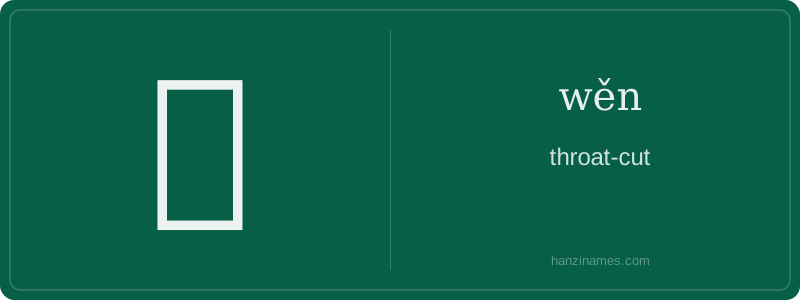
刎 appears most famously in the idiom 刎颈之交 (wěn jǐng zhī jiāo), recorded as early as the Records of the Grand Historian (Shǐjì, c. 94 BCE), describing the legendary friendship between Lìn Xiāngrú and Lián Pō. Though rare in modern speech, it survives in formal writing, historical dramas, and exams testing classical literacy. You’ll also find it in academic discussions of Confucian ethics or Chinese historiography.
The character’s form is not pictographic but phono-semantic: the left part (丿) is a simplified phonetic component historically linked to 'wěn', and the right side 刂 ('knife' radical) signals its meaning domain — cutting actions. No oracle bone or bronze script forms survive for 刎; it emerged later in seal script, reflecting its literary rather than colloquial origin.
Hi students! Today we’re learning 刎 (wěn), a relatively rare but powerful character meaning 'to cut across the throat' — not just any cut, but a decisive, often fatal one. It’s composed of two parts: the left side is 丿 (a falling stroke), and the right side is 刂 (the 'knife' radical), which tells us immediately this character involves cutting or sharp action. Though it looks simple with only six strokes, its meaning carries serious weight in classical and literary Chinese.
This character doesn’t appear in everyday spoken Mandarin — you won’t hear it at the market or in casual chats. Instead, it lives in historical texts, idioms, and formal writing where dramatic or symbolic self-sacrifice or loyalty is described. Think of ancient warriors or loyal ministers choosing death over dishonor — that’s the world where 刎 belongs. Its tone (third tone) is important: wěn, like saying 'wun' while dipping your voice down then up.
Don’t confuse 刎 with more common cutting verbs like 切 (qiē, to slice) or 割 (gē, to cut off). 刎 is specific, visceral, and culturally loaded. It’s used almost exclusively in set phrases like 刎颈之交 (wěn jǐng zhī jiāo), describing an unbreakable bond — literally, 'friends who’d cut each other’s throats together', meaning absolute trust and loyalty. Mastering 刎 helps you read classical literature and understand deep cultural values around honor and sacrifice.
Example Sentences
Common Compounds
Similar Characters — Don't Mix These Up
Your First Step into Chinese Culture: Get a Chinese Name
Every journey into Chinese begins with a name. Use our free Chinese name generator to create a meaningful, personalized Chinese name that fits you perfectly.
Get My Chinese Name →