刜
Character Story & Explanation
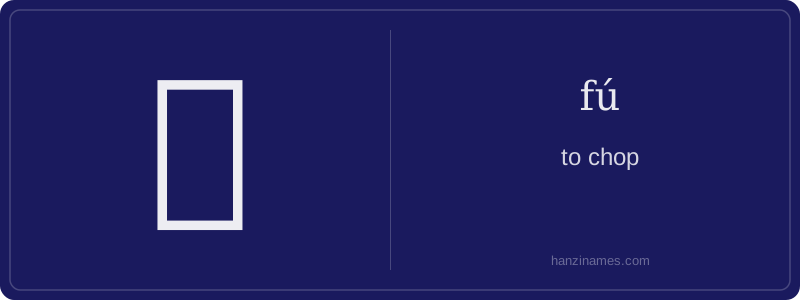
刜 is virtually absent from contemporary spoken Mandarin and does not appear in any HSK vocabulary list (HSK 1–9). It survives only in classical literature and historical texts—for example, in the Shuō Yuàn (Garden of Stories, c. 15 BCE), where it describes a minister’s decisive execution of a corrupt official: '乃刜之' ('then he struck him down'). It also appears in Tang poetry and Ming-era military manuals as a verb denoting a downward, blade-driven severance—never slicing or scraping.
The character 刜 is a phono-semantic compound: the left radical 刂 (knife/blade) signals meaning; the right component 弗 (fú) provides sound. 弗 itself originally depicted a rope tied across a ‘mouth’ (囗), meaning ‘to forbid’—but here it serves phonetically. No oracle bone or bronze script forms of 刜 are attested; it first appears reliably in Han dynasty bamboo slips and clerical script inscriptions as a specialized variant of 砍 (kǎn), emphasizing vertical force.
Imagine a misty autumn morning in a rural village near Hangzhou, where an elderly woodcutter stands beside a gnarled camphor tree. With a single, decisive motion, he raises his broad-bladed axe—its edge glinting faintly—and brings it down with a sharp, clean *thwack*. The sound echoes across the valley: not a slow sawing, but a swift, forceful chopping action. This is 刜 (fú): not mere cutting, but the vigorous, downward strike of a heavy blade—precise, powerful, and final.
Unlike common verbs like ‘cut’ (切 qiē) or ‘chop’ (砍 kǎn), 刜 carries literary weight and historical texture. It appears almost exclusively in classical Chinese texts, poetry, and martial-arts narratives—not in grocery lists or cooking shows. Its rarity makes it a linguistic artifact: a word preserved like a well-oiled antique dao sword in a museum case, admired for its precision and resonance rather than daily utility.
Modern Mandarin speakers rarely utter 刜 aloud; most encounter it first while reading Tang dynasty poetry or studying classical prose. When used, it evokes immediacy and violence—a warrior’s cleaving blow, a poet’s metaphor for sudden rupture. Its power lies in economy: one character, two strokes (in its simplified form), yet it conveys momentum, direction, and impact. Learning 刜 isn’t about ordering food—it’s about unlocking layers of literary voice and historical action.
Example Sentences
Common Compounds
Similar Characters — Don't Mix These Up
Your First Step into Chinese Culture: Get a Chinese Name
Every journey into Chinese begins with a name. Use our free Chinese name generator to create a meaningful, personalized Chinese name that fits you perfectly.
Get My Chinese Name →