剁
Character Story & Explanation
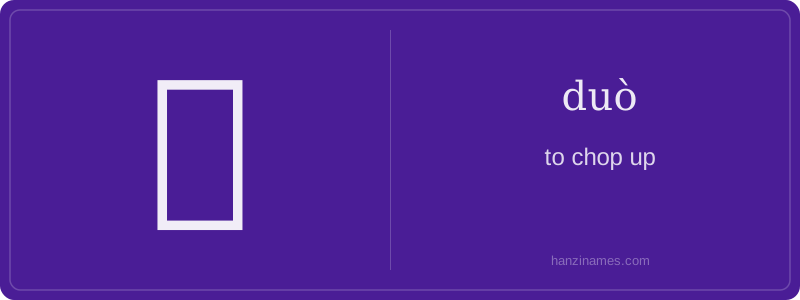
In modern Mandarin, 剁 is overwhelmingly used in culinary contexts—especially in home cooking and street food preparation. It appears in standard phrases like 剁肉馅 (duò ròu xiàn, 'to mince meat') and is essential in making dumpling fillings, baozi stuffing, or Sichuan-style spiced minced pork. The character also appears in the idiom 剁手 (duò shǒu, lit. 'chop hand'), a humorous internet slang term from the early 2010s meaning 'to impulsively shop online until you want to chop off your own hand'—a vivid metaphor for buyer’s remorse.
The character 剁 does not appear in oracle bone or bronze inscriptions. It emerged later, likely during the Han dynasty or after, as a derivative of 刀 (dāo, knife) + phonetic 朵. Its form is not pictographic but functional: the radical 刂 clearly marks it as a cutting action, while 朵 provides consistent pronunciation. Today, Chinese cooks routinely use 剁 when preparing dishes like jiaozi or wontons—often with a heavy cleaver and rhythmic 'thunk-thunk-thunk' heard in kitchens across China.
Our detective begins at the crime scene: the character 剁 (duò), an 8-stroke action verb meaning 'to chop up'—not just cut, but repeatedly, vigorously, and often with intent to mince. Its right-hand component 刂 (the 'knife' radical) is a telltale signature: every character bearing this radical relates to cutting, slicing, or incision—like 刻 (kè, to engrave) or 利 (lì, sharp). This radical anchors the character’s semantic field in physical, blade-driven force.
The left side, 朵 (duǒ), originally meant 'a flower blossom' (as in 一朵花, yī duǒ huā), but here serves purely as a phonetic clue—its pronunciation duǒ is close to duò, signaling how the character should be read. This is a classic example of a phono-semantic compound: one part hints at sound, the other at meaning. No floral gentleness remains; the blossom has been weaponized into rhythm and impact.
Zooming out, 剁 reflects Chinese lexical efficiency: a single character captures both motion and result—chopping *into small pieces*, often for cooking or preparation. Unlike English verbs that require adverbs ('chop finely') or compounds ('mince'), 剁 inherently implies fragmentation through repetition and force. Its eight strokes—starting with the horizontal stroke of 朵 and ending with the decisive downward stroke of 刂—mirror the chopping motion itself: down, down, down.
Example Sentences
Common Compounds
Similar Characters — Don't Mix These Up
Your First Step into Chinese Culture: Get a Chinese Name
Every journey into Chinese begins with a name. Use our free Chinese name generator to create a meaningful, personalized Chinese name that fits you perfectly.
Get My Chinese Name →