穿
Character Story & Explanation
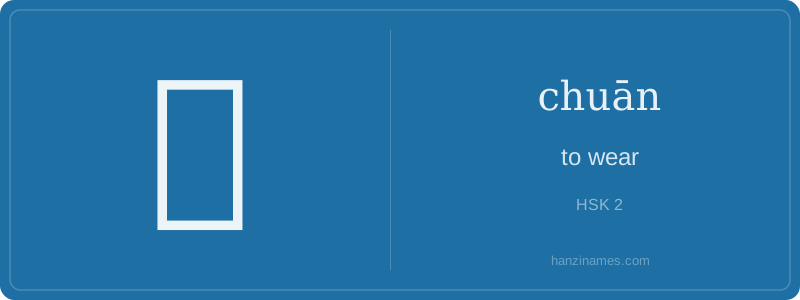
穿 is ubiquitous in modern Mandarin: from weather reports ('今天很冷,要多穿点') to fashion blogs and e-commerce product tags ('显瘦穿搭'). It appears in the common phrase 穿搭 (chuān dā, 'outfit coordination'), widely used on social media like Xiaohongshu. Historically, 穿 appears in Tang dynasty texts describing court dress codes, and in Ming-Qing novels like Jin Ping Mei, where characters’ attire reflects social status — always marked by 穿, not 戴 or 带.
The character evolved from seal script, where the top part (穴) represented an opening and the bottom (牙 + 工-like element) suggested 'passing through'. By the Han dynasty, it standardized as a semantic-phonetic compound: 穴 (meaning 'penetration') + 川 (chuān, phonetic hint). No oracle bone form survives — its earliest confirmed use is in bronze inscriptions circa 5th century BCE, denoting 'to pierce through' before narrowing to 'wear'.
Hi students! Let’s learn 穿 (chuān), a very practical HSK Level 2 character meaning 'to wear' — especially for clothes, shoes, or accessories. It’s not used for putting on hats (that’s 戴) or glasses (also 戴), but specifically for items that go *through* or *over* the body: shirts, pants, socks, coats. Think of it as 'slipping something on' — like threading your arms through sleeves. This verb is essential for daily conversations about weather, fashion, or getting ready.
The character has 9 strokes and belongs to the 穴 (xué) radical — meaning 'cave' or 'hole'. That may seem odd at first, but historically, 穴 here signals a *penetrating action*: clothing passes *through* openings (neck, arms, legs), just as something might pass through a cave-like space. Don’t worry about memorizing ancient logic — focus on modern usage: subject + 穿 + object (e.g., 我穿裙子 — 'I wear a skirt').
Remember: 穿 is always transitive — it needs a direct object (what you’re wearing). You can’t say 'I wear' alone; you must say 'I wear *something*'. Also, it’s commonly paired with time words (e.g., 现在穿什么?— 'What are you wearing now?') or adjectives (e.g., 穿得暖和 — 'dressed warmly'). Practice using it in full sentences — not just vocabulary lists — to build real fluency!
Example Sentences
Common Compounds
Similar Characters — Don't Mix These Up
Your First Step into Chinese Culture: Get a Chinese Name
Every journey into Chinese begins with a name. Use our free Chinese name generator to create a meaningful, personalized Chinese name that fits you perfectly.
Get My Chinese Name →