离
Character Story & Explanation
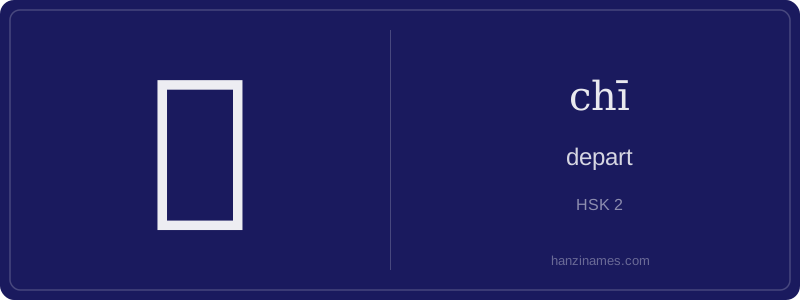
The character 离 (lí) is one of the most frequently used verbs in modern Mandarin, appearing in HSK 2 vocabulary and everyday speech. It’s central to phrases like 离开 (líkāi, 'to leave'), 分离 (fēnlí, 'to separate'), and 离婚 (líhūn, 'divorce'). Historically, 离 appears in classical texts such as the *I Ching* (Yìjīng), where the hexagram 离 (Lí) symbolizes 'Fire' and 'Clinging' — reflecting brightness, dependence, and transformative separation. This philosophical use remains culturally resonant today.
Its earliest attested form (in seal script) shows a simplified pictographic evolution — likely derived from a representation of two objects moving apart — though scholars agree its current shape is primarily phonosemantic, not pictorial. Modern usage focuses on relational and spatial distance: e.g., '离…很近/远' ('very near/far from…') is among the top 20 grammar patterns taught in beginner textbooks.
Wait — there’s an important correction to make right away: the character 离 is pronounced lí (not chī), and it does NOT mean 'mythical beast'. The pronunciation 'chī' and meaning 'mythical beast' actually belong to a different, much rarer character: 麒 (qí, as in qilin), or sometimes 螭 (chī), which is a hornless dragon-like creature. 离 is a common, high-frequency character — HSK Level 2 — with core meanings like 'to depart', 'to separate', 'to be away from', and 'to divorce'. It’s essential for daily communication, appearing in verbs, adjectives, and compound words.
Visually, 离 is often mistaken as complex, but its structure is logical: it combines the radical 禸 (a rare component historically linked to animal tracks or paw prints) with a phonetic element 禹 (yǔ, an ancient sage-king). However, modern learners rarely analyze it this way — instead, they learn it as a unified shape meaning 'separation'. Its stroke order (10 strokes) follows standard rules: left-to-right, top-to-bottom, with careful attention to the distinctive 'upward hook' in the final stroke of the upper part.
Don’t let the radical 禸 confuse you — it’s not used in many other characters, and it doesn’t convey 'beast' here. In fact, 离 has no zoological meaning whatsoever. Its ancient oracle-bone or bronze script origins are debated, but by the Han dynasty, it already carried meanings of separation and distance. Today, it appears everywhere: in signs ('离站台50米' — '50 meters from the platform'), apps ('离线模式' — 'offline mode'), and emotional expressions ('舍不得离开' — 'hate to leave'). Mastering 离 unlocks clarity in time, space, and relationships.
Example Sentences
Common Compounds
Similar Characters — Don't Mix These Up
Your First Step into Chinese Culture: Get a Chinese Name
Every journey into Chinese begins with a name. Use our free Chinese name generator to create a meaningful, personalized Chinese name that fits you perfectly.
Get My Chinese Name →