票
Character Story & Explanation
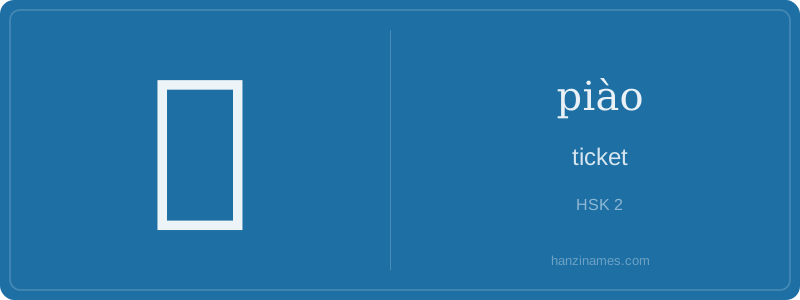
Historically documented since the Song dynasty, 票 emerged as an official voucher for grain distribution, salt licenses, and later, banknotes (e.g., Ming-era ‘baochao’ paper money bore 票-related terminology). Today, it’s ubiquitous: subway tickets (地铁票), movie tickets (电影票), and train tickets (火车票) are daily necessities. The idiom ‘买票排队’ (mǎi piào páiduì) — ‘queue to buy tickets’ — reflects real cultural behavior, especially during Spring Festival travel season, when billions secure transport tickets via apps like 12306.
The character’s form has no oracle-bone or bronze inscription origin—it first appears in clerical script (lìshū) around the Han dynasty. Its structure is phonosemantic: 示 (shì) signals ritual/official sanction, while the right side (originally 少+西, later standardized to 西) serves as a phonetic hint. No pictographic sun or tree here—just bureaucratic clarity forged in ink and inkstone.
Unearthing 票 (piào) feels like brushing dust from a Han dynasty bamboo slip—its form whispers of ritual, not rail travel. Originally tied to sacrificial offerings (hence the 示 radical, meaning 'altar' or 'divine sign'), early inscriptions show it as a token of authorization: a stamped slip granting access to sacred rites or state granaries. This wasn’t paper yet—it was authority made tangible, a physical warrant sanctioned by heaven and bureaucracy alike.
The character’s evolution mirrors China’s administrative revolution. By the Tang dynasty, 票 appeared in tax records and military dispatches as a standardized voucher—small, portable, and tamper-resistant. Its 11 strokes encode precision: the 示 radical anchors it in legitimacy, while the 口 (mouth) and 西 (west) components coalesced over centuries into a phonetic-semantic compound, where 西 once approximated the pronunciation *piào* in Middle Chinese dialects.
Modern usage retains this ancient weight: every metro ticket in Beijing, every concert pass in Shanghai, every stock certificate in Shenzhen carries the quiet gravity of a millennia-old covenant—proof granted, access conferred, trust encoded. The character hasn’t lost its ritual core; it’s simply migrated from temple altars to QR-code scanners, still functioning as society’s most trusted ‘token of passage’.
Example Sentences
Common Compounds
Similar Characters — Don't Mix These Up
Your First Step into Chinese Culture: Get a Chinese Name
Every journey into Chinese begins with a name. Use our free Chinese name generator to create a meaningful, personalized Chinese name that fits you perfectly.
Get My Chinese Name →