知
Character Story & Explanation
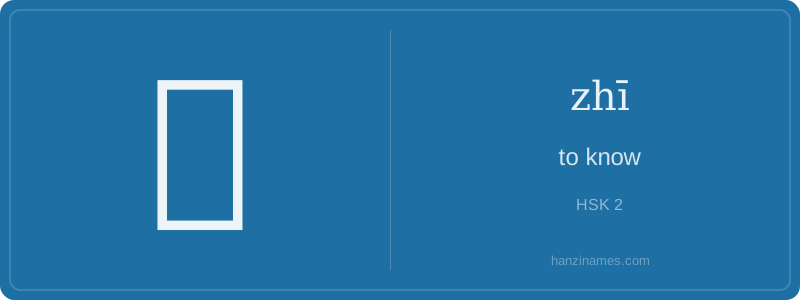
知 is ubiquitous in modern Mandarin: it appears in HSK 2 vocabulary like 知道 (zhīdào, 'to know'), the most frequent verb for factual awareness, and in classical idioms such as 一知半解 (yī zhī bàn jiě, 'superficial knowledge'). Historically, it was central to Confucian epistemology—the *Great Learning* opens with ‘The way to acquire knowledge lies in investigating things.’ Government exams (605–1905 CE) tested candidates’ 知 of classics, making this character foundational to elite literacy.
The character’s form is not pictographic but phono-semantic: 矢 (shǐ, ‘arrow’) provides sound (Old Chinese *təʔ), while 口 (kǒu, ‘mouth’) signals speech-based cognition. Oracle bone or bronze inscriptions lack 知; its earliest verified form appears in Warring States bamboo texts (c. 475–221 BCE), confirming its late Shang/early Zhou emergence as written language matured.
As an archaeologist brushing dust from a Warring States bamboo slip, I find 知 inscribed with startling clarity—not as a divine revelation, but as a pragmatic record of cognition. Its earliest secure attestation appears in the *Analects* (5th c. BCE), where Confucius uses it to distinguish mere information from embodied understanding: ‘To know what you know and what you do not know—this is true knowledge.’ The character anchors a philosophical shift: knowledge as relational, ethical, and verifiable—not mystical.
Excavations at Guodian (1993) revealed early forms of 知 on lacquered wooden strips, confirming its pre-Qin usage in administrative and pedagogical texts. Unlike later Neo-Confucian abstractions, these fragments treat 知 as actionable—‘knowing the seasons’ for farming, ‘knowing ritual norms’ for governance. The character’s consistency across centuries signals lexical stability rare in early Chinese writing, suggesting its semantic core was socially indispensable.
This stability reflects its structural logic: 矢 (arrow) as phonetic component + 口 (mouth) as semantic indicator—though modern scholarship confirms 口 was likely a later graphical simplification of an older, now-lost semantic element related to speech or declaration. Still, the mouth remains symbolically apt: to know is to articulate, affirm, or declare—echoing Aristotle’s ‘knowledge is power to speak truly.’ In ancient China, knowing meant being able to state correctly before elders, rulers, or scribes.
Example Sentences
Common Compounds
Similar Characters — Don't Mix These Up
Your First Step into Chinese Culture: Get a Chinese Name
Every journey into Chinese begins with a name. Use our free Chinese name generator to create a meaningful, personalized Chinese name that fits you perfectly.
Get My Chinese Name →