睛
Character Story & Explanation
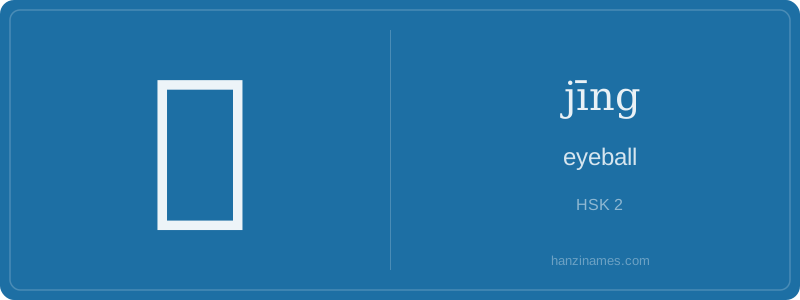
In modern Mandarin, 睛 appears almost exclusively in compound words—not alone. It’s central to HSK 2 vocabulary like 眼睛 (yǎnjing, ‘eye’) and idioms such as ‘画龙点睛’ (huà lóng diǎn jīng, ‘to add the finishing touch’), a phrase documented since the 5th-century *Records of the Southern Dynasties*, referring to the legendary painter Zhang Sengyou who brought a dragon to life by painting its pupils.
The character is not a pictograph. It evolved as a phono-semantic compound: 目 (radical, meaning ‘eye’) + 青 (phonetic, jīng, indicating sound). No oracle bone or bronze script forms of 睛 exist—its earliest confirmed appearance is in Warring States bamboo texts (475–221 BCE), where it consistently denotes the eyeball as a physiological and perceptual organ.
As an archaeologist brushing dust from a Han dynasty bamboo slip, I find 睛 inscribed not as a standalone word—but embedded in medical texts describing ‘clarity of vision’ and ‘liver-qi affecting the eyes’. Its radical 目 (eye) anchors it firmly in the visual realm, while the phonetic component 青 (qīng, ‘blue-green’) hints at ancient associations between eye health and vital qi—color symbolism linked to liver function in early Chinese medicine.
This character emerged fully formed in seal script (c. 3rd century BCE), already bearing its modern structure: 目 + 青. Unlike earlier pictographs like 目 itself—which clearly mimics an eye with eyelids and pupil—睛 shows no trace of oracle bone origins; it is a later, phono-semantic compound, born from linguistic need rather than visual imitation.
Excavations at Mawangdui (168 BCE) revealed silk manuscripts where 睛 appears alongside terms like ‘明睛’ (bright eyes) and ‘目睛動’ (eyeball movement), confirming its clinical use in diagnosing mental and physical states. The character wasn’t poetic ornament—it was diagnostic precision: ‘clear eyes’ signaled balanced yin-yang, while ‘dull 睛’ warned of internal depletion.
Example Sentences
Common Compounds
Similar Characters — Don't Mix These Up
Your First Step into Chinese Culture: Get a Chinese Name
Every journey into Chinese begins with a name. Use our free Chinese name generator to create a meaningful, personalized Chinese name that fits you perfectly.
Get My Chinese Name →