眼
Character Story & Explanation
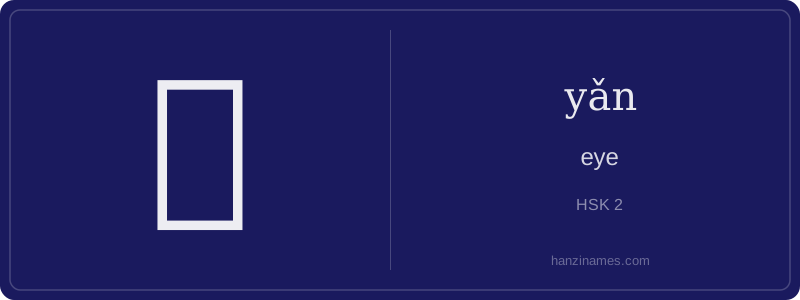
眼 is indispensable in daily Mandarin: it appears in HSK 2 vocabulary like 看见 (kànjiàn, ‘to see’) and forms core idioms such as ‘有眼不识泰山’ (yǒu yǎn bù shí Tàishān, ‘to have eyes but fail to recognize Mount Tai’—meaning to miss something obvious). Historically, it appears in the 2nd-century CE medical classic *Huangdi Neijing*, describing the eye as the ‘window of the liver’. It’s also central to traditional Chinese painting theory—‘eye-level composition’ (平视法 píngshì fǎ) governed spatial representation.
The character is a clear pictograph-derived ideograph: 目 (the radical) originally depicted an eye with pupil in oracle bone script (c. 1200 BCE), and 眼 added the phonetic 艮 later in the Warring States period (~475–221 BCE) to distinguish it from homophones. No speculative origin needed—it’s archaeologically verified across bronze inscriptions and bamboo manuscripts.
As an archaeologist brushing dust from a Han dynasty bamboo slip, I find 眼 not as a static glyph—but as a living stratigraphic layer. Its radical 目 (mù, 'eye') anchors it firmly in the visual realm, while the phonetic component 艮 (gèn) hints at ancient pronunciation shifts. Excavated inscriptions show 眼 replacing earlier characters like 瞚 in medical texts by the 3rd century CE, signaling standardization in anatomical terminology.
This character’s 11-stroke form crystallized during the clerical script (lìshū) transition—where rounded oracle-bone curves hardened into angular strokes. The top ‘目’ retains its pictographic essence: two eyelids framing pupils—still legible to modern eyes. Meanwhile, the lower 艮 subtly evokes ‘stillness’ or ‘limit’, perhaps reflecting classical Chinese medicine’s view of the eye as a bounded, sovereign organ governing liver qi.
Unlike Western ‘ocular’ roots tied to optics, 眼 carries embodied cognition: to ‘see’ is to ‘perceive deeply’ (e.g., 眼光 yǎnguāng, ‘insight’). In Tang poetry, 眼 appears in metaphors for perspective—‘a mountain’s eye’ meaning its most revealing vantage point. This semantic depth wasn’t carved in stone; it was worn smooth by centuries of poets, physicians, and philosophers tracing its strokes with ink and intent.
Example Sentences
Common Compounds
Similar Characters — Don't Mix These Up
Your First Step into Chinese Culture: Get a Chinese Name
Every journey into Chinese begins with a name. Use our free Chinese name generator to create a meaningful, personalized Chinese name that fits you perfectly.
Get My Chinese Name →