真
Character Story & Explanation
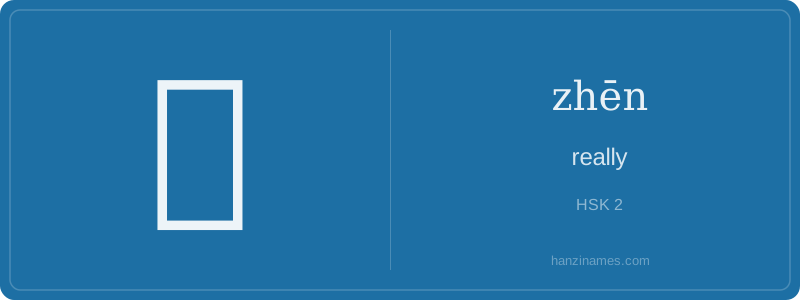
真 is ubiquitous in modern Mandarin: it’s essential in HSK exams, news headlines ('真相' — zhēnxiàng, 'the truth'), and everyday expressions like '真的吗?' (zhēn de ma? — 'Really?'). A well-documented idiom is '真心实意' (zhēnxīn shíyì), meaning 'sincere and earnest', frequently used in speeches and formal letters since at least the Ming dynasty. The character also appears in legal and media contexts emphasizing factual reporting.
The earliest attested form of 真 appears in seal script (c. 3rd century BCE), where it combined 目 (eye) with 匕 (an archaic variant of 'to transform') and 一 (horizontal line representing unity/wholeness). Scholars (e.g., Xu Shen in *Shuōwén Jiězì*, 100 CE) define it as 'that which is complete and unaltered' — not a pictograph, but a semantic compound stressing authenticity through clarity and wholeness.
Hi students! Let’s explore 真 (zhēn), a foundational HSK Level 2 character meaning 'really', 'truly', or 'genuine'. It appears constantly in daily speech — from confirming facts ('Is that true?') to praising sincerity ('a truly kind person'). Notice its radical 目 (mù, 'eye'): this reflects ancient Chinese thinking — truth is what you can *see clearly*, not just believe. Though modern usage is abstract, the visual anchor helps you remember it’s about authenticity and direct perception.
The character has 10 strokes, written with careful balance: start at the top-left, finish with the horizontal stroke under the eye. Practice slowly — each stroke matters! Unlike English adverbs like 'really', 真 often stands alone for emphasis ('真好!' = 'So good!'), or modifies adjectives/nouns directly ('真话' = 'true words'). It’s rarely used as a verb — think of it as a truth amplifier!
Remember: 真 isn’t just factual accuracy — it carries warmth and moral weight. Calling someone ‘真朋友’ (zhēn péngyou) means 'a real, loyal friend', not just 'a factually existing friend'. This cultural nuance is key: in Chinese, truth is tied to integrity and heart. As you learn, listen for how native speakers use 真 for emotional sincerity — not just logical correctness. That’s where fluency begins!
Example Sentences
Common Compounds
Similar Characters — Don't Mix These Up
Your First Step into Chinese Culture: Get a Chinese Name
Every journey into Chinese begins with a name. Use our free Chinese name generator to create a meaningful, personalized Chinese name that fits you perfectly.
Get My Chinese Name →