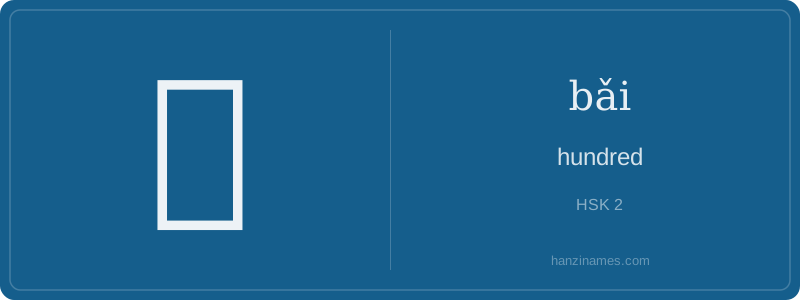
百
Character Story & Explanation
In Beijing’s bustling Panjiayuan Antique Market, vendors proudly display ‘百年老店’ (bǎi nián lǎo diàn)—‘century-old shops’—on red banners, invoking tradition and trust. The character 百 appears ubiquitously: in ‘百分之百’ (bǎi fēn zhī bǎi, ‘100%’), used in product guarantees; in ‘百花齐放’ (bǎi huā qí fàng), a famous 1950s cultural policy slogan meaning ‘let a hundred flowers bloom’; and in ‘百米赛跑’ (bǎi mǐ sàipǎo, ‘100-meter dash’), standard in sports reporting. It’s also central to the Chinese lunar calendar’s ‘百年’ (century) reckoning and imperial-era ‘百官’ (bǎi guān, ‘hundred officials’), denoting the civil bureaucracy.
The modern form of 百 evolved from oracle bone script, where it was written as a single vertical line crossed by two horizontal strokes—symbolizing completeness and totality. By the bronze script era, it standardized into a shape closely resembling today’s form, retaining its core function as the base unit for large quantities. No pictographic origin (e.g., no ‘100 objects’ depicted); rather, it’s a logographic abstraction representing numerical magnitude.
The character 百 (bǎi) meaning 'hundred' is one of the most frequently encountered numerals in Chinese—appearing on price tags, train schedules, exam scores, and festival banners. Its six-stroke form combines the radical 白 (bái, 'white') with a simplified top component historically derived from the ancient form of 'one hundred'. Though visually resembling 白, the extra horizontal stroke at the top distinguishes it clearly—a subtle but critical difference learners must master early.
Unlike English, where 'hundred' functions only as a noun or adjective, 百 serves flexibly: as a standalone numeral (e.g., 一百), a prefix in compounds (e.g., 百分之—'percent'), and even an intensifier meaning 'countless' or 'all' (e.g., 百花齐放, 'a hundred flowers bloom'). This semantic range reflects its deep integration into both quantitative logic and cultural metaphor in Chinese thought.
In spoken Mandarin, bǎi carries a third tone, requiring precise pitch contour to avoid confusion with bāi (to break) or bài (to worship). Its frequent pairing with 十 (shí, ten) and 千 (qiān, thousand) forms the backbone of Chinese number construction—making it indispensable for daily transactions, data literacy, and HSK-level communication. Mastery of 百 unlocks fluency far beyond counting—it’s the gateway to percentages, statistics, idioms, and historical chronology.
Example Sentences
Common Compounds
Similar Characters — Don't Mix These Up
Your First Step into Chinese Culture: Get a Chinese Name
Every journey into Chinese begins with a name. Use our free Chinese name generator to create a meaningful, personalized Chinese name that fits you perfectly.
Get My Chinese Name →