白
Character Story & Explanation
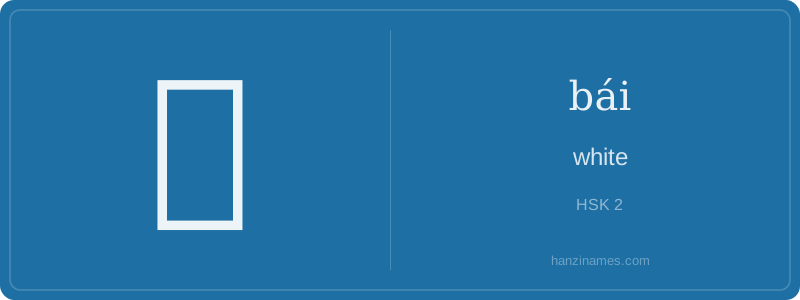
白 is ubiquitous in modern Mandarin: used in daily expressions like 白天 (bái tiān, 'daytime'), 白菜 (bái cài, 'Chinese cabbage'), and bureaucratic terms like 白条 (bái tiáo, 'IOU'). It appears in classical idioms such as 白手起家 (bái shǒu qǐ jiā, 'to start from nothing') and the Tang-dynasty poem line '白日依山尽' ('the white sun sinks behind the mountains')—a canonical image of cyclical harmony. The term 白话 (bái huà, 'vernacular speech') was central to China’s early 20th-century language reform movement.
Oracle bone and bronze inscriptions show 白 as a pictograph of the rising sun above a horizon line—its earliest form (c. 1200 BCE) depicted a sun with a dot or horizontal stroke representing its radiance. By the Warring States period, it standardized into the five-stroke form we use today, retaining its solar luminosity as semantic core.
White in Chinese thought is far more than a color—it embodies purity, clarity, and the unadorned truth. Unlike Western associations where white often signifies mourning (in some contexts), in traditional China it symbolizes brightness, openness, and the yang principle: light overcoming darkness, knowledge dispelling ignorance. This reflects a worldview where simplicity and transparency are moral ideals, not just aesthetic choices.
The character 白 appears in foundational Daoist and Confucian texts to denote sincerity and uncorrupted intent—'a white heart' (白心) meant integrity without pretense. Even today, calling someone ‘white’ (白) in phrases like 白纸 (bái zhǐ, 'blank paper') evokes potential, innocence, and readiness for cultivation—a metaphor deeply rooted in East Asian pedagogy and self-cultivation ethics.
Culturally, 白 also carries layered connotations: in medicine, it signals vitality (e.g., healthy skin tone); in theater, white face paint traditionally represents treachery (a deliberate inversion showing how meaning shifts with context). This duality reveals a core Chinese philosophical stance—that meaning arises from relationship and usage, not fixed essence. 白 thus becomes a lens into how Chinese language encodes dynamic, contextual wisdom.
Example Sentences
Common Compounds
Similar Characters — Don't Mix These Up
Your First Step into Chinese Culture: Get a Chinese Name
Every journey into Chinese begins with a name. Use our free Chinese name generator to create a meaningful, personalized Chinese name that fits you perfectly.
Get My Chinese Name →