病
Character Story & Explanation
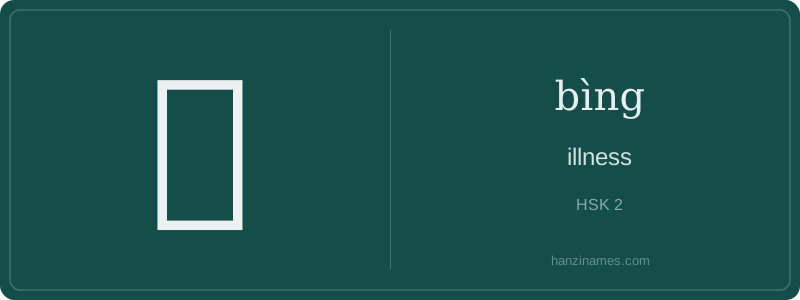
病 is ubiquitous in modern Mandarin: it appears in medical reports, public health campaigns (e.g., 疾病预防 'disease prevention'), and daily speech like 他生病了 ('He fell ill'). Historically, it appears in Tang dynasty medical texts such as Sun Simiao’s Qian Jin Yao Fang, where it consistently denotes pathological conditions—not just 'sickness' but clinically identifiable disorders. It’s central to idioms like 病入膏肓 (bìng rù gāo huāng), meaning 'beyond cure', documented since the Zuo Zhuan (4th c. BCE).
The character’s earliest confirmed form is in Warring States bamboo slips (c. 475–221 BCE), showing 疒 + 丙—no oracle bone version survives. Today, Chinese learners practice it using standardized stroke order: dot first, then horizontal stroke, then the 'sick-bed' enclosure. Its radical 疒 is always written before the phonetic 丙—a non-negotiable sequencing rule taught in all mainland textbooks.
As a linguistic detective, I begin at the crime scene: the character 病. Its radical 疒—'sickness frame'—is a telltale clue: it appears in nearly all illness-related characters (e.g., 疼 'pain', 疲 'fatigue'). This radical itself evolved from a pictograph of a person lying sick in bed, first seen in bronze inscriptions around 1000 BCE. The right side, 丙 (bǐng), was originally a phonetic component borrowed for its sound—not meaning—anchoring pronunciation while the left side handled semantic duty.
The character’s 10-stroke structure is tightly regulated: stroke order matters critically. Writing it out of sequence disrupts recognition and violates standard GB2312 encoding rules used in Chinese computing. In fact, official stroke-order databases (like the Ministry of Education’s 2021 Standard) list it as a model for compound-radical integration—showing how semantic and phonetic elements cohabit under strict orthographic law.
This duality—meaning on the left, sound on the right—is classic xíngshēng (phonosemantic) construction, used in over 80% of modern Chinese characters. 病 exemplifies how ancient scribes solved the problem of scaling writing systems: instead of inventing new pictographs for every ailment, they reused reliable radicals and swapped phonetics. No wonder it entered HSK Level 2—it’s a foundational key unlocking hundreds of health-related terms.
Example Sentences
Common Compounds
Similar Characters — Don't Mix These Up
Your First Step into Chinese Culture: Get a Chinese Name
Every journey into Chinese begins with a name. Use our free Chinese name generator to create a meaningful, personalized Chinese name that fits you perfectly.
Get My Chinese Name →