男
Character Story & Explanation
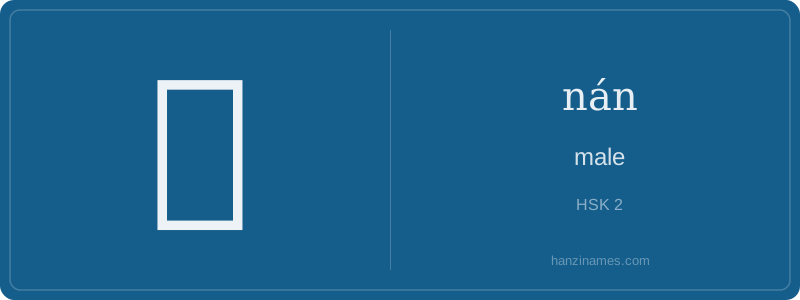
In daily life, 男 appears ubiquitously: on public restroom signs (男 / 女), in ID forms (性别: 男), and common phrases like 男生 (nánshēng, 'male student') and 男士 (nánshì, 'gentleman'). It’s central to idioms such as 男尊女卑 (nán zūn nǚ bēi, 'men superior, women inferior'), reflecting historical Confucian norms — though this phrase is now critically discussed in modern education. The character also features in official statistics (e.g., 男性人口, 'male population') and media headlines.
The character 男 first appeared in bronze inscriptions (c. 11th–3rd century BCE) as a compound of 田 (field) and 力 (strength), literally 'one who works the fields' — a documented semantic construction reflecting agrarian social roles. Unlike mythic or unverified oracle-bone interpretations, this etymology is supported by early script analysis (e.g., in the *Shuōwén Jiězì*, 100 CE).
Hello, learners! Let’s explore the character 男 (nán), meaning 'male' or 'man'. It’s a foundational HSK Level 2 character — simple in form but rich in usage. You’ll see it everywhere: on restroom doors, in job ads, family terms, and official documents. Its seven-stroke structure is easy to master once you understand its two-part logic: the top part (‘field’ 田) and bottom part (‘strength’ 力). Don’t worry about memorizing strokes all at once — we’ll break it down step by step!
This character reflects traditional Chinese societal roles: historically, men were associated with fieldwork and physical labor — hence the combination of 田 (field) and 力 (strength/power). While modern usage is gender-neutral in many contexts (e.g., ‘male nurse’ 男护士), it still carries cultural weight in terms like 男朋友 (boyfriend) or 男性 (male adult). Understanding 男 helps unlock dozens of compound words and clarifies gender-related vocabulary.
As a teacher, I encourage you to practice writing 男 while saying ‘nán’ aloud — this builds muscle memory and pronunciation together. Notice how the radical 田 appears in other characters like 畏 (to fear) and 留 (to stay), but only with 力 does it mean ‘male’. That’s the beauty of Chinese: meaning emerges from combinations. Use flashcards with real-life images (e.g., a man farming, a ‘men only’ sign) to strengthen recall. You’re not just learning a word — you’re learning a cultural lens.
Example Sentences
Common Compounds
Similar Characters — Don't Mix These Up
Your First Step into Chinese Culture: Get a Chinese Name
Every journey into Chinese begins with a name. Use our free Chinese name generator to create a meaningful, personalized Chinese name that fits you perfectly.
Get My Chinese Name →