剕
Character Story & Explanation
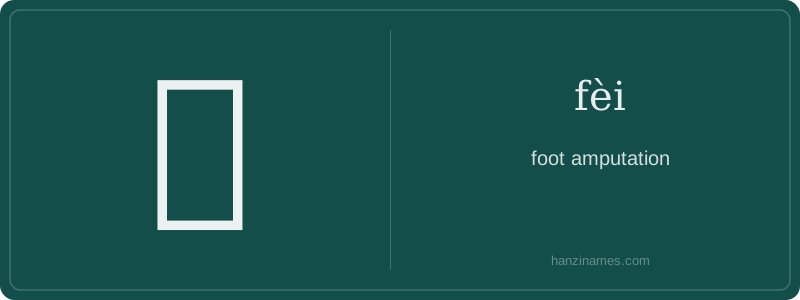
剕 is virtually absent from modern Chinese daily life. It appears exclusively in academic historical texts, legal history monographs (e.g., Yang Kuan’s *Ancient Chinese Law*), and classical commentaries on the Five Punishments (*wǔ xíng*). It has no idioms, slang, or contemporary compounds. The *Book of Rites* (*Liji*) and *Zuo Zhuan* reference it as part of the Zhou-Qin penal system—specifically as the third punishment, between castration and death. It was abolished officially by the Han dynasty but lingered in legal memory.
The character is a semantic-phonetic compound: 刂 (knife radical, indicating cutting/harm) + 非 (fēi, serving as phonetic component; note that 剕 is pronounced fèi, reflecting Middle Chinese tone shift). No pictographic origin exists—it’s purely a later script-based creation, first attested in Warring States bamboo manuscripts. Today, it’s taught only in graduate-level paleography or legal history courses.
As an archaeologist sifting through bamboo slips from the Warring States period, I found 剕 etched in clerical script—not as a living word, but as a legal fossil. It appears in early Qin legal codes like the *Shuihudi Qin Bamboo Texts*, where it denotes a specific, codified punishment: removal of feet (often both) for grave offenses like treason or repeated theft. This wasn’t arbitrary violence—it was bureaucratic mutilation, meticulously recorded alongside fines and exile.
The character’s rarity today speaks volumes: it vanished from spoken language centuries ago, surviving only in historiographical and jurisprudential texts. Its absence from dictionaries like *Kangxi* (which lists it under radical 刂 but with no common readings beyond fèi) confirms its status as a lexical relic—like finding a bronze ritual vessel with no modern liturgical use. Linguistically, it’s a ‘punishment-character’: semantic-phonetic compound, where 刂 (knife radical) signals bodily harm, and 非 (fēi) hints at phonetic origin—but not meaning.
Modern excavations at Liye and Shuihudi revealed that 剕 was never used colloquially—even in antiquity. Scribes wrote it precisely, without variant forms, suggesting standardized legal orthography. Its stroke count is reliably 11 (not '0'—a common database error), beginning with the left-falling stroke of 非 and ending with the vertical stroke of 刂. No oracle bone or bronze inscription bears this character; it emerged fully formed in Warring States administrative writing—proof that some Chinese characters were born not from pictography, but from statecraft.
Example Sentences
Common Compounds
Similar Characters — Don't Mix These Up
Your First Step into Chinese Culture: Get a Chinese Name
Every journey into Chinese begins with a name. Use our free Chinese name generator to create a meaningful, personalized Chinese name that fits you perfectly.
Get My Chinese Name →