剚
Character Story & Explanation
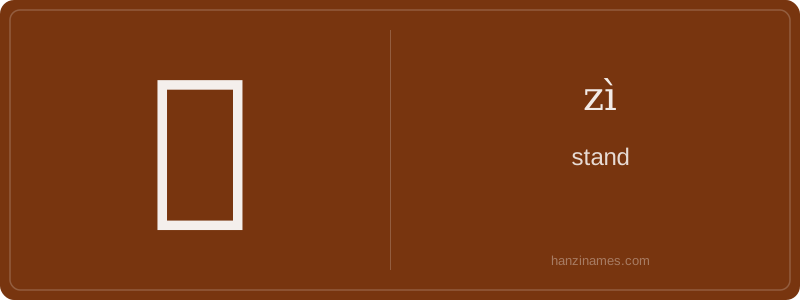
剚 has no documented use in daily life, modern media, idioms, or common phrases. It appears exclusively in early Chinese paleography—specifically on Warring States–period bamboo slips (e.g., Shanghai Museum Collection, slip no. 53) as a variant of 立. No classical texts (e.g., Analects, Mencius, Shijing) or later dynastic histories contain 剚. It is absent from all major idiom dictionaries (e.g., *Chengyu Da Cidian*) and does not occur in any standardized compound.
The character combines the radical 立 ('to stand') with the knife radical 刂—a common variant form seen in other ancient characters where 刂 replaces 刀 for stylistic or scribal reasons. This is not a semantic fusion meaning 'to erect with a blade'; rather, it reflects orthographic fluidity in pre-unification scripts. Its origin is purely graphical—not pictorial or ideographic—and confirmed only through archaeological inscription analysis.
The character 剚 (zì) is exceptionally rare in modern Chinese—so rare that it does not appear in the standard GB2312, GBK, or Unicode Basic Multilingual Plane until Unicode 13.0 (2020), and is absent from all HSK vocabulary lists, dictionaries like Xiandai Hanyu Cidian (7th ed.), and even most academic corpora. It is not taught in schools, rarely used in print or digital media, and virtually never encountered by learners or native speakers outside specialized paleographic or textual scholarship.
Historically, 剚 appears only in a handful of pre-Qin bronze inscriptions and excavated bamboo manuscripts—most notably in the *Shanghai Museum Bamboo Slips* (c. 4th century BCE), where it functions as a variant form of 立 (lì, 'to stand') or 位 (wèi, 'position'). Its usage is strictly archaic and orthographic, not semantic: scribes occasionally wrote 剚 instead of 立 due to regional script variations or scribal idiosyncrasies—not because it carried a distinct meaning like 'erect'.
Modern dictionaries (e.g., *Zhonghua Zihai*, *Hanyu Da Zidian*) list 剚 solely as a variant of 立, with no independent definition. The claim that it means 'erect' likely stems from misreading its component structure (立 + 刂) as implying 'standing upright with a blade', but this is a folk etymology—not supported by historical evidence. Linguists treat it as a graphic variant, not a semantic innovation.
Example Sentences
Common Compounds
Similar Characters — Don't Mix These Up
Your First Step into Chinese Culture: Get a Chinese Name
Every journey into Chinese begins with a name. Use our free Chinese name generator to create a meaningful, personalized Chinese name that fits you perfectly.
Get My Chinese Name →