剜
Character Story & Explanation
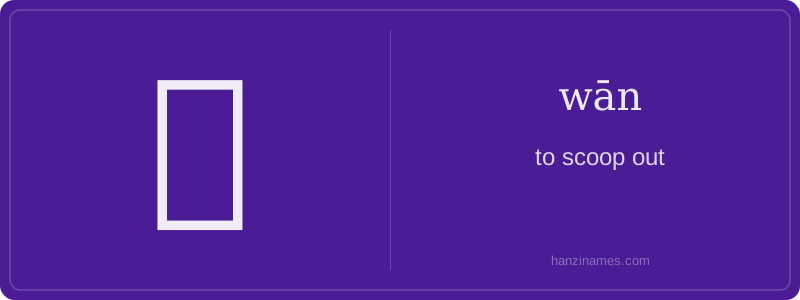
剜 is commonly used in modern Chinese in medical reports (e.g., tumor removal), woodworking manuals, and literary descriptions of intense suffering. It appears in the classical idiom 剜肉补疮 (wān ròu bǔ chuāng)—'scooping flesh to patch a sore', meaning a desperate, self-damaging fix—documented as early as the Ming dynasty (14th–17th c.) in economic critiques. Today, surgeons and artisans still use it precisely in professional discourse.
The character is not pictographic but phono-semantic: the left component 元 (yuán) suggests pronunciation (archaic *wan), while the right radical 刂 (knife) signals meaning. No oracle-bone or bronze script forms survive; it first appears in seal script (c. 3rd c. BCE) as a compound indicating 'knife-action on something foundational'. In daily life, you’ll hear it in hospital briefings or craft workshops—not casual speech—but always with technical or rhetorical precision.
剜 (wān) is a precise, somewhat vivid verb meaning 'to scoop out'—typically with a sharp tool like a knife or chisel. It implies deliberate, forceful removal of material from a solid surface: flesh, wood, stone, or even abstract things like pain or emotion in literary usage. Unlike generic verbs like 'remove' or 'cut', 剜 conveys depth, effort, and often a slight sense of violence or intensity.
In English, the closest equivalents are 'gouge out', 'excavate', or 'scoop out'—but none fully capture its cultural weight. In Western contexts, 'gouging' often carries negative connotations (e.g., gouging eyes), while 剜 appears neutrally in craftsmanship (woodcarving), medicine (surgical debridement), and literature (e.g., '剜心'—'to tear out one’s heart', expressing extreme sorrow). This reflects Chinese linguistic tolerance for visceral imagery in emotional expression.
Compared to Western medical or artisanal terminology—which favors Latin-derived, technical terms (e.g., 'debride', 'excise')—剜 remains a compact, monosyllabic, everyday word used across registers. Its radical 刂 (knife) visually anchors it to cutting tools, reinforcing semantic transparency rare in English synonyms. This direct link between form, meaning, and action makes 剜 an excellent case study in how Chinese characters encode embodied cognition.
Example Sentences
Common Compounds
Similar Characters — Don't Mix These Up
Your First Step into Chinese Culture: Get a Chinese Name
Every journey into Chinese begins with a name. Use our free Chinese name generator to create a meaningful, personalized Chinese name that fits you perfectly.
Get My Chinese Name →