剟
Character Story & Explanation
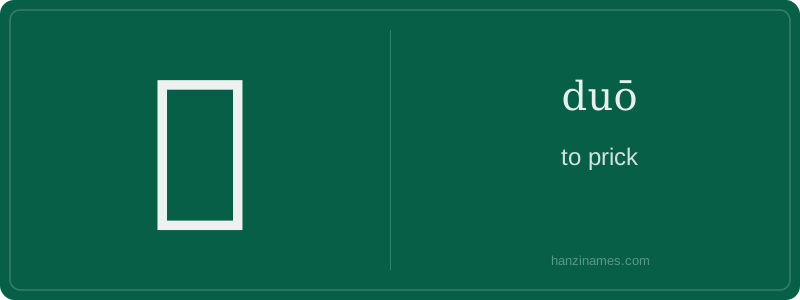
剟 is virtually absent from modern spoken Mandarin and does not appear in any HSK level, contemporary dictionaries (e.g., Xiàndài Hànyǔ Cídiǎn), or common corpora. It appears only in premodern texts, such as Song- and Ming-dynasty technical writings on engraving, seal carving, and traditional medicine—where it describes the act of making fine, repeated incisions. No idioms or set phrases containing 剟 are recorded in authoritative sources like the *Great Dictionary of Chinese Characters* (《汉语大字典》).
The character is composed of the radical 刂 (knife/blade) on the right and duō (多, 'many') on the left—a phono-semantic compound. Its documented origin is not pictographic but analytical: 多 suggests repetition (many pricks), 刂 indicates the tool (knife-like instrument). This structure aligns with standard late-zhuan (seal script) formation principles, not oracle-bone inscriptions. Today, it is encountered only by specialists—calligraphers restoring antique rubbings or scholars editing classical craft manuals.
The Chinese character 剟 (duō) is a rare, highly specialized verb meaning 'to prick', 'to stab lightly', or 'to puncture repeatedly with a sharp tool'. Unlike common action verbs, it carries a precise, almost technical connotation—often implying controlled, repetitive, shallow penetration, as in engraving, acupuncture, or leatherworking. Its usage is largely confined to classical texts, technical manuals, or literary descriptions where tactile precision matters more than general action.
Compared to English verbs like 'prick', 'poke', or 'stab', 剟 emphasizes intentionality and fineness—not aggression or injury. Western equivalents include the surgical term 'lancet' (a fine, pointed instrument), the artisan’s 'burin' in engraving, or the acupuncturist’s precise needle insertion. It evokes not pain but craftsmanship: think of dot-matrix printing, stippling in ink wash painting, or tattoo outlining—actions defined by discrete, deliberate punctures rather than sweeping motion.
In cultural context, 剟 reflects the Chinese tradition of valuing micro-precision in craft and medicine—akin to how Japanese *sashiko* stitching or German *Stippen* (stippling) use repeated dots for structure and texture. While English often defaults to 'poke' or 'pierce', 剟 resists casualness; it belongs to contexts where each puncture has purpose—like marking calligraphy paper for alignment, or scoring jade before cleavage. Its rarity underscores how Chinese lexical richness preserves nuance lost in broader Western terms.
Example Sentences
Common Compounds
Similar Characters — Don't Mix These Up
Your First Step into Chinese Culture: Get a Chinese Name
Every journey into Chinese begins with a name. Use our free Chinese name generator to create a meaningful, personalized Chinese name that fits you perfectly.
Get My Chinese Name →