铲
Character Story & Explanation
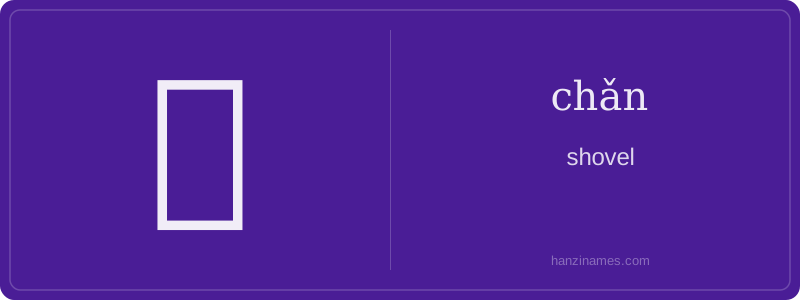
In contemporary China, 铲 is ubiquitous on construction sites, rural farms, and even city sidewalks after snowfall. Workers use 铲子 (chǎnzi, 'shovel') daily; municipal crews in Beijing or Harbin deploy large-scale 铲车 during winter storms. The verb 铲 (chǎn) appears in official language too — e.g., 铲除黑恶势力 (chǎnchú hēi è shìlì, 'eradicate criminal gangs'), a key phrase in China’s 2018–2020 anti-organized crime campaign, widely reported by Xinhua and CCTV.
The character’s form is not pictographic but phono-semantic: the left radical 钅 denotes metal tools, and the right 产 (chǎn) serves as both phonetic clue and semantic contributor — historically linked to ‘producing’ or ‘bringing forth’, extended here to ‘removing’ (as in clearing soil to prepare for planting or building). No oracle-bone or bronze inscription evidence exists for 铲; it first appeared reliably in Song-era texts referring to agricultural implements.
铲 (chǎn) is a practical, action-oriented character rooted in manual labor — literally depicting the act of shoveling or scraping earth with a metal-edged tool. Its left radical 钅 (jīn), meaning 'metal', signals that the tool is made of metal — historically iron or steel — while the right component 产 (chǎn) hints at production or removal, reinforcing the idea of excavating or clearing ground.
This character embodies China’s agrarian and infrastructural heritage: from ancient irrigation projects to modern urban construction,铲 has been indispensable. Unlike abstract characters, it reflects tangible human interaction with land — turning soil, removing snow, or preparing foundations. Its 11-stroke structure balances precision and utility, mirroring the tool’s function: firm, direct, and grounded.
Though not in the HSK official lists (HSK Level: Not included),铲 appears frequently in vocational, technical, and colloquial contexts — especially in compound words like 铲车 (chǎnchē, 'front-end loader') or 铲除 (chǎnchú, 'to eradicate'). It carries both literal and metaphorical weight: to physically dig, or figuratively eliminate something undesirable — a duality common in Chinese semantic extension.
Example Sentences
Common Compounds
Similar Characters — Don't Mix These Up
Your First Step into Chinese Culture: Get a Chinese Name
Every journey into Chinese begins with a name. Use our free Chinese name generator to create a meaningful, personalized Chinese name that fits you perfectly.
Get My Chinese Name →