剸
Character Story & Explanation
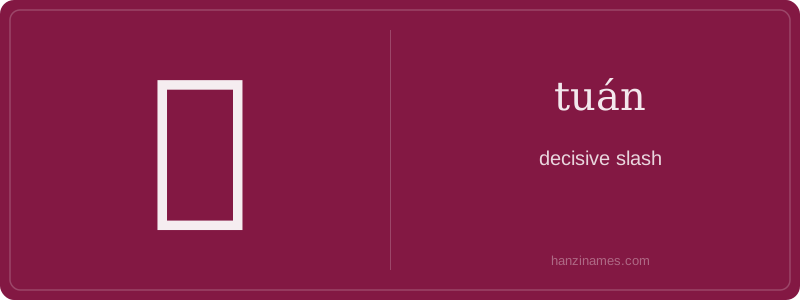
剸 is virtually unused in contemporary spoken or written Mandarin. It appears only in classical texts, scholarly editions, and rare idiomatic allusions—never in newspapers, social media, or daily conversation. The *Complete Library of the Four Treasuries* (Siku Quanshu) cites it in legal contexts describing the severing of corrupt officials’ ranks. No modern HSK textbook includes it, and it is absent from the People’s Republic’s General List of Modern Chinese Characters (2013).
Its earliest secure attestation is in Warring States bamboo slips (c. 4th–3rd BCE), where it appears as a verb meaning 'to cut off decisively'. The character combines the phonetic element 端 (duān, 'end') and the knife radical 刂—confirming its core semantic link to termination via cutting. Though not pictographic, its form reflects functional orthography: precision + instrument.
As a linguistic detective, I begin with the character 剸—rare, archaic, and strikingly precise. Its pronunciation tuán suggests a sharp, rolling consonant-vowel blend, echoing the swift motion of a blade cutting through resistance. Unlike common verbs like qiē (cut) or gē (slash), 剸 carries a classical weight: it denotes a decisive, often ceremonial or judicial act of cleaving—not just slicing, but *severing with authority*. This nuance places it firmly in pre-modern legal and ritual texts, not modern kitchens or offices.
The character’s structure reveals little at first glance—it contains no obvious blade radical (like 刂 or 刀), nor does it follow standard phonetic-semantic compound logic. Its left component (耑) is an ancient phonetic element meaning 'tip' or 'end', hinting at precision and termination; the right side (刂) *is* the knife radical—but only in later forms. In bronze inscriptions, the knife component appears inconsistently, suggesting 剸 evolved as a specialized variant rather than a foundational pictograph.
Crucially, 剸 is not a living character in spoken Mandarin. It survives almost exclusively in literary allusions, historical law codes, and poetic diction—like a fossilized verb preserved in amber. Its rarity means even native speakers may misread it as tuān or dùn without context. Yet its endurance in texts like the *Book of Rites* and Tang dynasty legal commentaries proves its semantic power: to 剸 is to cut *with finality*, to resolve complexity by incisive division—a concept resonating deeply in Chinese philosophical traditions valuing clarity and decisive action.
Example Sentences
Common Compounds
Similar Characters — Don't Mix These Up
Your First Step into Chinese Culture: Get a Chinese Name
Every journey into Chinese begins with a name. Use our free Chinese name generator to create a meaningful, personalized Chinese name that fits you perfectly.
Get My Chinese Name →