劄
Character Story & Explanation
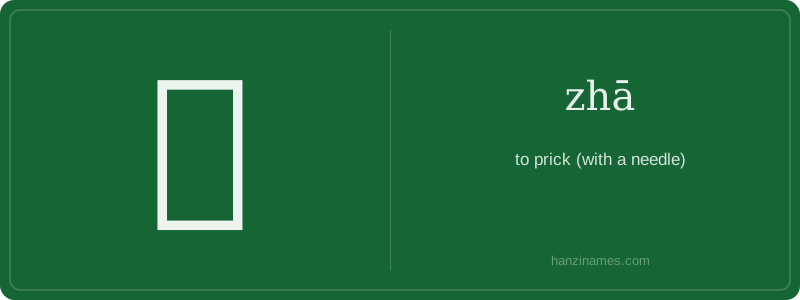
Historically, 劄 appears in pre-modern medical texts like the Huangdi Neijing commentaries and Song dynasty acupuncture manuals, consistently meaning 'to insert a needle precisely'—not merely pierce, but to engage meridian qi. It survives today primarily in literary or academic contexts, especially in Classical Chinese studies and traditional medicine education. While rarely used colloquially, it appears in formal compound terms like 劄刺 (zhā cì, 'acupuncture puncture') and historical reenactments of imperial medical examinations.
The character is not pictographic—it evolved from seal script where ⺮ (bamboo) + 戛 (a phonetic component suggesting abrupt contact) coalesced during the Han dynasty. Its form reflects phonosemantic construction, not visual depiction. In modern life, Chinese learners encounter it mainly in advanced HSK-6+ reading passages on traditional medicine or classical literature—not in daily speech.
As an archaeologist sifting through layers of textual sediment, I uncover 劄 not in oracle bones—but in Tang dynasty medical manuscripts and Song-era acupuncture treatises. Its bamboo radical ⺮ signals early writing materials: the character first appears carved on slips where physicians recorded needle techniques. The right-hand component 戛 (jiá), though phonetic, echoes sharp, abrupt motion—like a needle’s sudden penetration. This isn’t metaphor; it’s biomechanical notation fossilized in script.
The character’s 14 strokes form a deliberate rhythm: three horizontal bamboo strokes top the frame, then a descending ‘cut’ (戈) morphs into the needle’s thrust—mirroring how Han dynasty acupuncturists described ‘entering the vessel with controlled force’. No abstract ideogram here: 劄 is a procedural glyph, encoding dosage, angle, and tissue resistance in its structure. Its rarity today reflects standardization—not obsolescence.
Unlike common characters reshaped by clerical script, 劄 resisted simplification. In Ming dynasty pharmacopeias, it appears alongside precise needle depths (e.g., ‘3 fen deep at BL10’). Modern dictionaries list it as literary or technical—yet its persistence in classical texts reveals something deeper: Chinese medicine never reduced needling to ‘piercing’, but to *regulated insertion*, a concept 劄 alone preserves with surgical precision.
Example Sentences
Common Compounds
Similar Characters — Don't Mix These Up
Your First Step into Chinese Culture: Get a Chinese Name
Every journey into Chinese begins with a name. Use our free Chinese name generator to create a meaningful, personalized Chinese name that fits you perfectly.
Get My Chinese Name →