劐
Character Story & Explanation
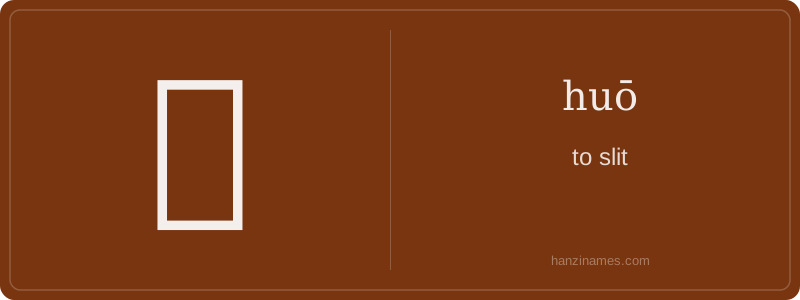
In contemporary rural China—especially in Hebei, Shandong, and Shanxi provinces—older farmers may still refer to ‘huō dì’ (劐地) when describing the traditional method of using a narrow-bladed, forward-thrusting tool to slit shallow furrows for sowing millet or sorghum. Though mechanized ploughs dominate today, the term persists in local agricultural extension materials and dialect dictionaries. The compound 劐开 (huō kāi, 'to slit open') appears in 20th-century agronomy handbooks published by the Ministry of Agriculture.
This character is not pictographic nor derived from oracle bones. Its earliest attestation is in Ming–Qing dynasty agricultural treatises, where it consistently denotes a controlled, linear incision—distinct from chopping or slicing. Today, Chinese speakers most commonly encounter 劐 in written contexts: technical manuals, regional folk narratives, or as part of compound words like 劐开 or 劐刀.
The character 劐 (huō) vividly captures the sharp, decisive action of cutting or slitting—especially with a knife. Its right-side radical 刂 (knife) signals its connection to cutting tools and actions, while the left side 豁 suggests openness or splitting apart, reinforcing the idea of cleaving through material. This duality makes 劐 more precise than generic verbs like 切 (qiē, 'to cut')—it implies a single, forceful incision that opens or separates.
Though rare in modern spoken Mandarin, 劐 remains vital in technical, agricultural, and craft contexts—particularly in northern China where traditional farming tools like the ‘huō knife’ (劐刀) are still referenced. It appears in regional dialects and agricultural manuals describing soil preparation: e.g., using a hoe-like tool to slit furrows before planting. Its rarity in daily speech contrasts with its functional precision in domain-specific usage.
The pronunciation huō (first tone) is standard; huò (fourth tone) occurs only in fixed classical compounds like 豁劐 (huò huō), now largely archaic. Unlike high-frequency characters, 劐 isn’t taught in HSK exams—it’s absent from all six levels—making it a specialized lexical item rather than a core vocabulary word. Learners encounter it most often in historical texts, regional literature, or technical glossaries—not textbooks.
Example Sentences
Common Compounds
Similar Characters — Don't Mix These Up
Your First Step into Chinese Culture: Get a Chinese Name
Every journey into Chinese begins with a name. Use our free Chinese name generator to create a meaningful, personalized Chinese name that fits you perfectly.
Get My Chinese Name →