劓
Character Story & Explanation
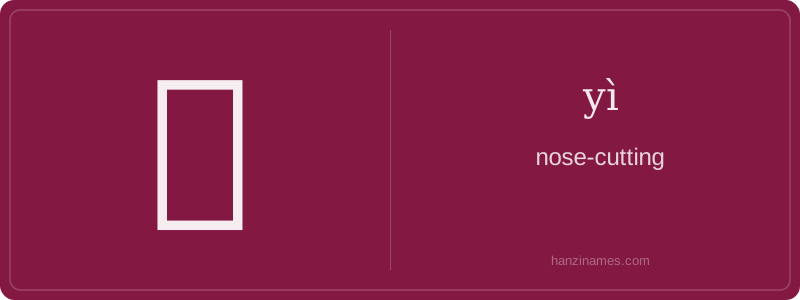
劓 is virtually unused in modern spoken or written Mandarin outside academic, legal-historical, or classical literary contexts. It appears in scholarly discussions of pre-Qin law (e.g., the ‘Five Punishments’ — 五刑), referenced in texts like the Zuo Zhuan and Han-era commentaries. No idioms or common phrases contain 劄 today; it has no presence in HSK vocabulary lists or contemporary media. Its sole real-world function is as a lexical artifact in history classrooms and paleographic research.
The character’s origin is documented: oracle bone and bronze inscriptions show a pictographic nose (鼻) with a knife (刂) beside or cutting it. By the Warring States period, the form stabilized into the current structure—combining 肉 (flesh, often abbreviated as 月 in radicals) and 刂—confirming its literal, anatomical meaning. No folk etymology or mythic origin is attested.
Unearthing 劓 (yì) feels like brushing dust from a bronze ritual vessel—its sharp, incised lines whisper of Shang and Zhou legal codes. This character isn’t abstract: it’s a forensic artifact. The radical 刂 (knife) anchors it in material violence, while the upper component, 肉 (ròu, ‘flesh’) or its variant form, signals bodily violation. In excavated bamboo slips from the Qin dynasty, 劓 appears in statutes listing punishments—precise, chilling, administrative.
Unlike poetic or philosophical characters, 劄 was functional bureaucracy made visible. Its 16 strokes follow a strict order: first the flesh component (with its internal ‘moon’-like 月 radical), then the knife—never reversed. Paleographers note that early forms show a nose-like glyph above the knife; later seal script standardizes it into today’s structure. Every stroke served jurisdictional clarity—not artistry, but legibility for scribes enforcing state power.
Modern eyes rarely encounter 劄 outside historical texts or classical exams—but its resonance lingers. It exemplifies how Chinese writing encodes law, not just language. To read 劄 is to hold a fragment of ancient penal philosophy: punishment as visible, irreversible inscription on the body. No metaphor here—only nose, knife, and consequence. Its silence in daily speech speaks volumes about China’s legal evolution from corporal severity to procedural reform.
Example Sentences
Common Compounds
Similar Characters — Don't Mix These Up
Your First Step into Chinese Culture: Get a Chinese Name
Every journey into Chinese begins with a name. Use our free Chinese name generator to create a meaningful, personalized Chinese name that fits you perfectly.
Get My Chinese Name →