劖
Character Story & Explanation
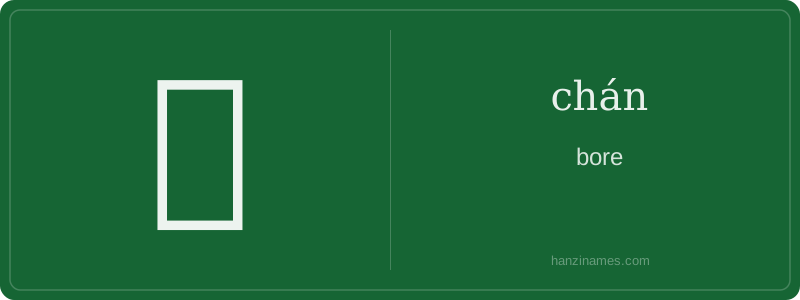
劖 is virtually unused in contemporary spoken or written Mandarin. It appears only in pre-modern texts—especially Ming- and Qing-dynasty technical manuals on metallurgy, carpentry, and stone carving—and occasionally in annotated editions of classical poetry where precise tool-related verbs were preserved. No idioms or set phrases containing 劖 are recorded in standard corpora (e.g., the CCL Corpus or BCC Corpus), and it is absent from all HSK vocabulary lists and modern textbooks.
The character is a phono-semantic compound: the left radical 刂 (knife/blade) signals its association with cutting tools, while the right component 毚 (chán, now obsolete as an independent character) provides phonetic guidance. Though 毚 itself is no longer used, historical dictionaries (e.g., *Kangxi Zidian*) confirm this structure. Today, Chinese learners will encounter 劖 only in specialized academic contexts—not daily life.
The character 劖 (chán) is an archaic and highly specialized Chinese character meaning 'to bore' or 'to pierce with a sharp tool'—specifically in the context of drilling holes, carving through hard material, or perforating. Unlike common modern verbs like zuān (钻) for 'drill', 劖 appears almost exclusively in classical texts, technical historical records, or poetic diction. Its usage evokes precision, force, and penetration—more mechanical and deliberate than metaphorical.
In Western cultural equivalents, 劖 aligns closely with the English verb 'bore' as used in engineering ('bore a hole in steel') or woodworking ('bore a mortise'), rather than the colloquial 'bore' meaning 'to weary'. Comparable terms include Latin *forare* (to pierce), German *bohren*, or French *percer*—all emphasizing physical penetration, not psychological tedium. This semantic precision distinguishes 劖 from homophones like chán (蝉, cicada) or chǎn (谄, to flatter).
While English speakers might associate 'boring' with monotony, 劖 carries no connotation of dullness—it’s strictly technical and tactile. Think of a blacksmith boring a hinge pinhole in iron, or a stonemason carving a drainage channel: actions requiring strength, control, and purposeful incision. This stark functional focus makes 劖 a rare but vivid lexical artifact—preserved in dictionaries and classical commentaries, yet virtually absent from spoken Mandarin today.
Example Sentences
Common Compounds
Similar Characters — Don't Mix These Up
Your First Step into Chinese Culture: Get a Chinese Name
Every journey into Chinese begins with a name. Use our free Chinese name generator to create a meaningful, personalized Chinese name that fits you perfectly.
Get My Chinese Name →