劘
Character Story & Explanation
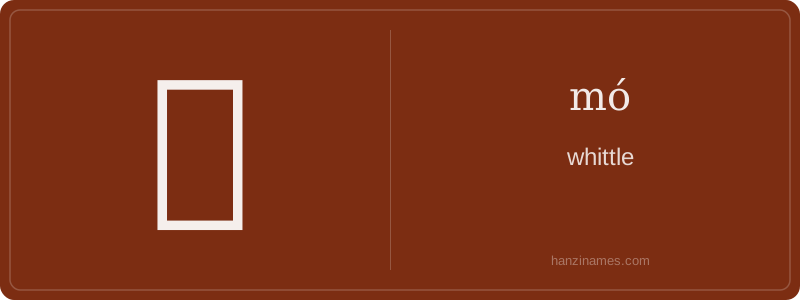
劘 appears in classical Chinese texts like the Wen Xuan (Selections of Refined Literature, 6th c.) and in Song-Ming Neo-Confucian essays describing moral self-refinement. A well-documented phrase is 劘厉 (mó lì), meaning 'to sharpen through mutual criticism'—used by scholar-officials to describe rigorous intellectual exchange. It is also found in official histories, e.g., the Ming Shi, where ministers are praised for '劘切君过' ('whittling away the ruler’s faults' via candid remonstrance).
The character is not pictographic; its structure combines the 'knife' radical (刂) on the right with '摩' (mó, 'to rub') on the left—a phonetic-semantic compound. The knife radical signals cutting action, while '摩' provides pronunciation and reinforces the sense of friction-based shaping. No oracle bone or bronze script forms survive—its earliest attestation is in Han dynasty bamboo slips and early dictionaries like the Shuowen Jiezi.
劘 (mó) is a rare, literary character meaning 'to whittle', 'to shave off gradually', or 'to erode bit by bit'—often used metaphorically for persistent, patient refinement. It evokes the image of a master craftsman carefully removing thin shavings from wood or jade, not in haste, but with disciplined precision. Though seldom seen in daily speech, it appears in classical texts and formal writing to convey deliberate, incremental change.
This character carries strong connotations of perseverance and quiet transformation. In Confucian and Daoist thought, 劘 reflects the ideal of self-cultivation: not sudden enlightenment, but steady, humble effort—like chiseling away at one’s flaws over years. Its tone is solemn and refined, reserved for essays on moral discipline or historical analyses of institutional reform.
Because 劘 is almost exclusively literary, modern learners rarely encounter it outside advanced reading—such as Tang dynasty poetry or Ming-Qing scholarly commentaries. It’s absent from HSK vocabulary lists (HSK Level: Not in HSK), and even native speakers may pause to recall its meaning. Yet its endurance in elite discourse testifies to Chinese culture’s deep respect for gradual mastery over quick results.
Example Sentences
Common Compounds
Similar Characters — Don't Mix These Up
Your First Step into Chinese Culture: Get a Chinese Name
Every journey into Chinese begins with a name. Use our free Chinese name generator to create a meaningful, personalized Chinese name that fits you perfectly.
Get My Chinese Name →