劙
Character Story & Explanation
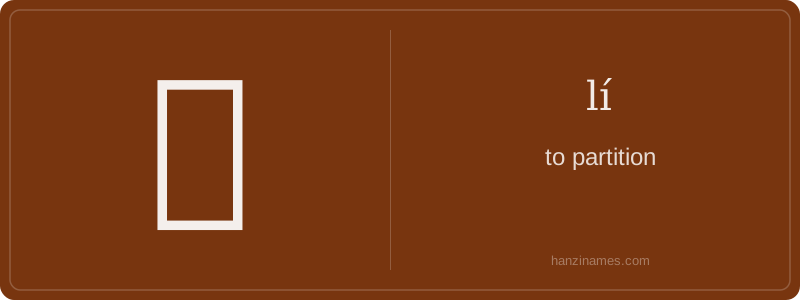
劙 is virtually unused in modern spoken Mandarin and absent from daily media, textbooks, or social platforms. It appears only in historical land records, pre-20th-century legal commentaries (e.g., Qing dynasty *Da Qing Hui Dian*), and rare literary allusions to territorial division. No idioms (chengyu) contain 劙, and it’s excluded from all HSK levels. Its usage is strictly archival or scholarly—never in news, education, or casual speech.
The character is a phono-semantic compound: 刂 (knife radical) + 黎 (lí, phonetic and semantic hint: ‘masses’ or ‘dawn’). While 黎 originally depicted ‘black hair’ (with 禾 ‘grain’ + 氺 ‘water’ + 勹 ‘enclosure’), here it functions primarily as a sound cue. In practice, Chinese linguists and historians encounter 劙 only when transcribing Qing-era cadastral documents—where it denotes legally binding partition of farmland among lineage branches.
Our detective work begins with a startling anomaly: 劙 (lí) has no entry in the modern HSK syllabus, appears in no standard frequency lists, and is absent from most digital dictionaries—yet it’s real, documented, and historically attested. Its rarity makes it a linguistic ‘cold case’: not obsolete, but deliberately specialized. We find it almost exclusively in classical texts and technical agricultural or legal terminology, where precise division of land or resources mattered deeply.
Tracing its structure, 劙 combines the ‘knife’ radical (刂, right-side variant of 刀) with the phonetic component 黎 (lí), which originally meant ‘black-haired people’ or ‘dawn’, later connoting ‘multitude’ or ‘common people’. This pairing suggests an action performed *by* or *upon* the collective—partitioning shared territory, dividing communal fields, or apportioning obligations. The knife radical signals agency, sharpness, and irrevocability—not gentle separation, but decisive, incisive division.
Unlike common synonyms like 分 (fēn) or 切 (qiē), 劙 carries judicial or administrative weight. It evokes boundary stones being set, deeds being drawn, or feudal plots carved from wilderness. No oracle bone or bronze script forms survive for 劙—it emerged late, likely during the Han or Wei-Jin period, as bureaucratic language formalized. Its scarcity today isn’t extinction; it’s preservation in niche lexicons—like a legal term surviving only in statutes, not conversation.
Example Sentences
Common Compounds
Similar Characters — Don't Mix These Up
Your First Step into Chinese Culture: Get a Chinese Name
Every journey into Chinese begins with a name. Use our free Chinese name generator to create a meaningful, personalized Chinese name that fits you perfectly.
Get My Chinese Name →