劾
Character Story & Explanation
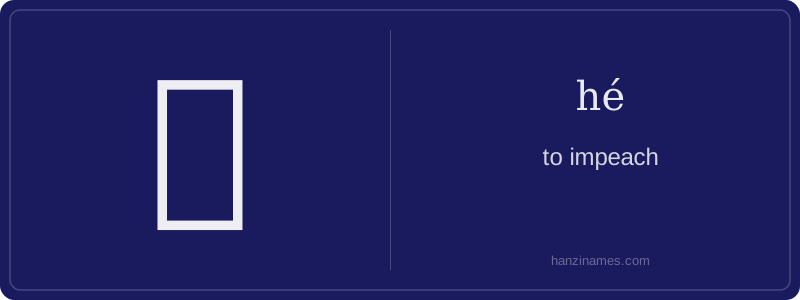
劾 is used today primarily in formal writing: news reports on anti-corruption investigations, historical documentaries about imperial censors, and legal commentary. It appears in fixed phrases like '弹劾' (tán hé)—though note: 弹劾 is the modern compound; 劾 alone is archaic and rarely stands independently in contemporary texts. Historically, from the Han Dynasty onward, '御史' (imperial censors) submitted '劾奏' (hè zòu)—memorials of impeachment—to the emperor. These were binding documents, not suggestions.
The character 劾 is a phono-semantic compound: the left component '亥' (hài) provides sound (historical pronunciation closer to *gə̂*), while the right '力' (lì, 'strength', 'effort') signals action and official force. It first appeared in seal script during the Warring States period and was standardized in the Qin dynasty’s Small Seal Script—confirmed by excavated bamboo slips from Shuihudi (217 BCE). No pictographic origin; its structure reflects bureaucratic function, not natural imagery.
The character 劾 (hé) is a formal, historically rooted verb meaning 'to impeach'—specifically, to formally accuse a government official of misconduct before an authoritative body. Unlike general criticism or reporting, 劾 carries legal and bureaucratic weight, implying due process, evidence, and institutional sanction. It appears almost exclusively in political, historical, or legal contexts—not in casual speech—and reflects China’s long tradition of administrative oversight, notably through imperial censors during the Han to Qing dynasties.
In modern usage, 劾 is rare in everyday language but remains vital in academic, journalistic, and legal discourse when referencing formal accountability mechanisms. Its rarity underscores how impeachment in Chinese political culture is institutionally embedded rather than populist: it requires authorized actors (e.g., supervisory commissions), not public petitions. This contrasts sharply with Western media-driven impeachment narratives, where political spectacle often overshadows procedural rigor.
Comparatively, Western equivalents like 'impeach' (U.S.) or 'censure' (UK) involve legislative bodies and partisan dynamics, whereas 劾 historically belonged to a non-legislative, meritocratic censorate—officials appointed for integrity, not elected. While U.S. impeachment can lead to removal *after* trial, 劾 itself was the initiating act, often resulting in immediate demotion or investigation. Thus, 劾 emphasizes procedural initiation and moral authority over political contestation—a distinction critical for understanding Chinese governance semantics.
Example Sentences
Common Compounds
Similar Characters — Don't Mix These Up
Your First Step into Chinese Culture: Get a Chinese Name
Every journey into Chinese begins with a name. Use our free Chinese name generator to create a meaningful, personalized Chinese name that fits you perfectly.
Get My Chinese Name →