勐
Character Story & Explanation
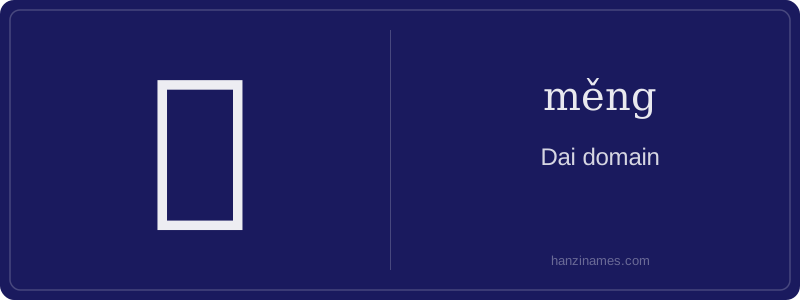
勐 is used almost exclusively in place names across southern Yunnan Province, especially in Dai-influenced regions — e.g., Mengla County (勐腊县), Menghai County (勐海县), and Jinghong’s former name, Cheli (车里) — where 'Meng' denotes a traditional Dai administrative unit, akin to a 'chiefdom' or 'principality'. It appears in official PRC geographic nomenclature, road signs, and civil registry documents.
The character has no attested oracle bone or bronze script form. Its earliest verified appearance is in Ming–Qing dynasty local gazetteers transcribing Dai words like 'məŋ' (meaning 'settlement' or 'domain'). Today, Chinese speakers encounter it only on maps or when discussing Yunnan’s ethnic geography — never in idioms, literature, or conversation outside that context.
As a linguistic detective, I begin with the radical: 力 (lì), meaning 'strength' or 'power' — a clear semantic anchor. The right component, 孟 (mèng), serves phonetically, hinting at pronunciation while historically denoting 'eldest' or 'first' in ritual contexts. Together, they form 勐 — not a common character in modern Standard Mandarin, but one preserved almost exclusively in geographical names and ethnic terminology.
This character’s rarity in daily speech makes it a fossilized lexical artifact. Unlike high-frequency characters, 勐 lacks dictionary entries in most general Chinese-English references — it appears only in specialized gazetteers and ethnolinguistic studies. Its survival is due entirely to administrative continuity: official maps, government documents, and minority-language transliteration standards have kept it alive for over half a century.
Crucially, 勐 is not a variant or simplification of another character — it’s a distinct, standardized form in the PRC’s 2013 List of Commonly Used Standard Chinese Characters (通用规范汉字表), classified as Level 3 (specialized use). Its 10-stroke structure follows strict stroke order: horizontal, vertical, dot, then the 力 radical last — a deliberate, muscular closure that echoes its semantic root.
Example Sentences
Common Compounds
Similar Characters — Don't Mix These Up
Your First Step into Chinese Culture: Get a Chinese Name
Every journey into Chinese begins with a name. Use our free Chinese name generator to create a meaningful, personalized Chinese name that fits you perfectly.
Get My Chinese Name →