勰
Character Story & Explanation
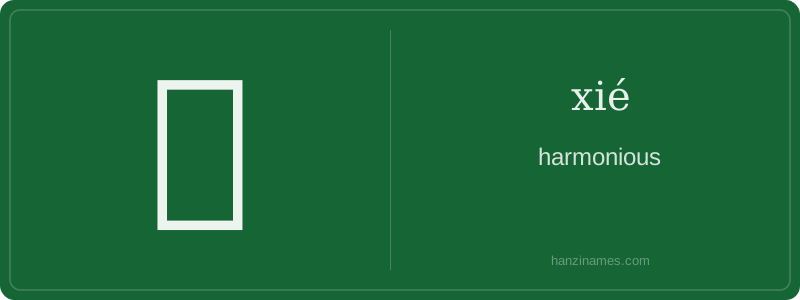
勰 is most famously used in the title of the 6th-century literary classic 《文心雕龙》 (Wén Xīn Diāo Lóng, 'The Literary Mind and the Carving of Dragons'), where the chapter '勰术' (Xié Shù) discusses the art of harmonizing style and substance in writing. In modern usage, it appears in official phrases like '协力勰同' (xié lì xié tóng)—a formal expression for 'united effort and harmonious coordination'—often seen in government white papers and CCTV documentaries on social cohesion.
The character is a phono-semantic compound: the top part 劦 (jié) means 'three people working together' and serves as both semantic and phonetic hint, while the bottom 力 (lì, 'strength') is the radical. It first appeared in standardized form in the *Shuōwén Jiězì* (121 CE), classified under the 力 radical—not as a pictograph, but as a deliberate fusion of cooperative action and force.
Hello students! The character 勰 (xié) is a beautiful, somewhat formal word meaning 'harmonious' or 'working together in unity.' Though not common in everyday spoken Chinese, it appears frequently in written contexts—especially in political speeches, official documents, and literary texts—to express deep cooperation and mutual support. Its elegance comes from its balanced structure: three 'together' components (劦) combined with the 'strength' radical (力), suggesting harmony achieved through collective effort.
Don’t confuse 勰 with simpler synonyms like 和 (hé, 'peace') or 协 (xié, 'cooperate'). 勰 carries a loftier, almost classical tone—it’s the kind of word you’d find in ancient texts like the *Wen Xin Diao Long* (a 6th-century literary theory masterpiece) or modern slogans about national unity. Because it’s composed of repeated 'three people cooperating' (劦) plus 力, it visually reinforces the idea that harmony isn’t passive—it’s active, intentional, and powered by shared will.
This character is rarely used alone; instead, it shines in compound words like 协勰 (xié xié) or 勰同 (xié tóng), both meaning 'in unison' or 'in full agreement.' As a beginner, you’ll encounter it more in reading than speaking—but recognizing it helps you appreciate how Chinese values collective harmony as a form of strength. Think of it as 'harmony with muscle'—not just peace, but powerful, coordinated unity.
Example Sentences
Common Compounds
Similar Characters — Don't Mix These Up
Your First Step into Chinese Culture: Get a Chinese Name
Every journey into Chinese begins with a name. Use our free Chinese name generator to create a meaningful, personalized Chinese name that fits you perfectly.
Get My Chinese Name →