勋
Character Story & Explanation
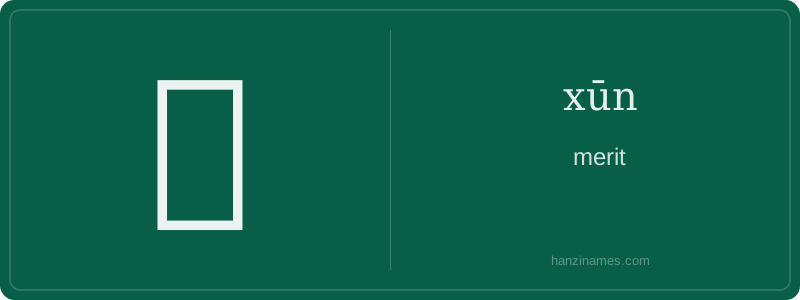
In modern China, 勋 appears most prominently in state honors: the 'Order of the Republic' (共和国勋章, Gònghéguó Xūnzhāng) — China’s highest civilian award — and military decorations like the 'August 1st Medal' (八一勋章). It is also used in formal contexts such as 'meritorious service' (立功, lìgōng) and academic citations for distinguished contributions. Idiomatically, it appears in 勋章 (xūnzhāng, 'medal') and 功勋 (gōngxūn, 'meritorious service'), both codified in official documents since the Ming dynasty.
The character’s form is well-documented: it evolved from seal script where 旬 (xún, 'ten-day period') served as the phonetic component, paired with 力 (lì, 'strength') as the semantic radical. This reflects its original bureaucratic meaning — merit tallied over time and validated by authority — not a pictorial representation. No oracle bone forms exist; earliest attestation is in Warring States bamboo slips (4th c. BCE), confirming its administrative origin.
As an archaeologist brushing dust from a Tang dynasty stele, I found 勋 etched beside military rosters—its form revealing not divine inspiration, but bureaucratic precision. The left side, 旬 (xún), originally denoted a ten-day cycle used in ancient calendrical and administrative records; the right side, 力 (lì), is the ‘strength’ radical—a clear marker of human effort recognized by the state. This was never a spontaneous glyph of heroism, but a logograph born in imperial archives: merit measured, recorded, and rewarded.
Excavations at Dunhuang’s manuscript caves revealed early variants where 旬 was sometimes written as 勳 with added dots—scribal flourishes indicating official validation. By the Song dynasty, 勋 had standardized into its modern shape, shedding phonetic ambiguity while retaining its core function: certifying exceptional service to the realm. Its nine strokes encode neither myth nor metaphor, but institutional memory—each stroke a ledger entry in China’s millennia-long meritocracy.
The character’s resilience lies in its adaptability: it survived dynastic collapse, script reforms, and digital encoding because it filled a non-negotiable semantic niche—‘officially recognized merit’. Unlike poetic characters that faded or mutated, 勋 remained anchored in legal, military, and ceremonial texts. Even today’s PLA commendation certificates and national science award plaques bear this same glyph, unchanged in structure since the 12th century—proof that some characters endure not through beauty, but bureaucratic necessity.
Example Sentences
Common Compounds
Similar Characters — Don't Mix These Up
Your First Step into Chinese Culture: Get a Chinese Name
Every journey into Chinese begins with a name. Use our free Chinese name generator to create a meaningful, personalized Chinese name that fits you perfectly.
Get My Chinese Name →