匉
Character Story & Explanation
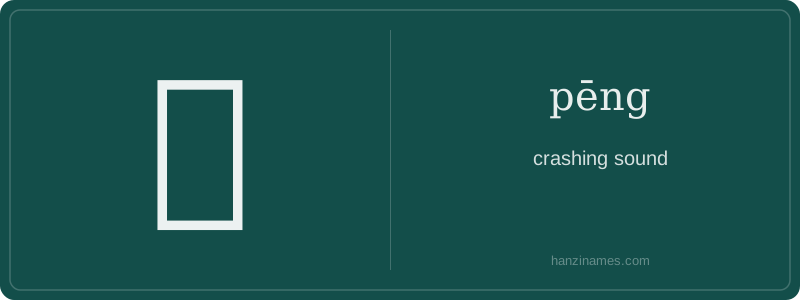
匉 is exceptionally rare in modern spoken and written Mandarin. It appears almost exclusively in classical-style poetry, literary descriptions, or onomatopoeic reduplications like 匉訇 (pēng hōng), meaning 'thunderous crashing'—often describing waterfalls, collapsing cliffs, or temple gongs. The compound 匉訇 is documented in Ming-Qing vernacular novels (e.g., Journey to the West chapter 34) and remains in literary usage today, though rarely in speech.
The character is not pictographic; it’s a later phono-semantic compound (形声字). Its left side 氵 is the standard water radical; the right side 亨 was chosen for approximate sound in Middle Chinese. No oracle bone or bronze script form exists—its earliest attestation is in Song-era dictionaries like the Jíyùn (1037 CE), confirming its status as a scholarly, not primordial, invention.
As an archaeologist sifting through layers of linguistic sediment, I find 匉 not in oracle bones or bronze inscriptions—but in the margins of classical poetry and late imperial prose. Its absence from early scripts tells a story: this is a phonosemantic creation, born not of pictorial necessity but of literary need—to capture the visceral, rhythmic crash of water that no existing character rendered precisely. It emerged when poets required onomatopoeic precision, not semantic abstraction.
This character is a sonic artifact: its left radical 氵 (water) anchors meaning, while the right component 亨 (hēng, originally 'to pass through' or 'prosper') serves phonetically—though its sound has drifted from hēng to pēng over centuries. Such divergence is common in Middle Chinese phonological shifts, confirmed by rhyme tables like the Guǎngyùn (1008 CE), where 匉 appears as a rare, specialized reading for water-sound effects.
Unlike high-frequency characters, 匉 was never standardized for daily use—it remained a stylistic tool for literati. Its scarcity in excavated texts underscores its function: not as a lexical workhorse, but as a brushstroke of auditory texture. To encounter 匉 is to hear a Tang dynasty poet pausing mid-line, listening—not to describe a river, but to *reproduce* its roar in ink and breath.
Example Sentences
Common Compounds
Similar Characters — Don't Mix These Up
Your First Step into Chinese Culture: Get a Chinese Name
Every journey into Chinese begins with a name. Use our free Chinese name generator to create a meaningful, personalized Chinese name that fits you perfectly.
Get My Chinese Name →